Showing posts with label l'ecriture humaine. Show all posts

Wednesday, February 19, 2020

The Man in the High Castle, Swastika Night, and l'Ecriture Humaine

I finished Philip K Dick's The Man in the High Castle, which I read as a companion piece to Katherine Burdekin's Swastika Night, both novels imagining a future in which the Nazis have won World War II. I will briefly discuss The Man in the High Castle (Swastika Night is covered in other blog entries) and then evaluate both as l'ecriture humaine. L'ecriture humaine works from the premise that the stories we tell have implications for the lives we lead. What kind of stories are we telling as culture? Are they humane or inhumane? Do they lead us toward or away from compassion? 

L'ecriture humaine has four aspects:

1. It shines a light on personal domestic spaces, the spaces often overlooked, dismissed or derogated by the dominant discourse. These  spaces depict small scale community, class difference and sociality. They are where human relationships can be nurtured or exposed. If, as Stalin said, the death of one person is a tragedy and the death of a million a statistic, l'ecriture humaine focuses on the one person.

2. It tends toward the circular, not the linear. Life is not progress towards a defined end goal but a series of reiterative relationships, a return to the same ground in order to deepen it.  

3. It rejects degradation or humiliation of any individual or group as a rite of passage or a definition of their humanity.

4. It foregrounds empathy and compassion.


This is  always a literature of truth, not lies, of sentiment, not sentimentality,  of telling difficult stories with an ethical compass pointing at empathy, compassion and forgiveness.


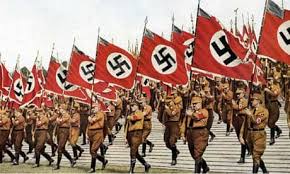
A work of  l'ecriture humaine can be filled with violence, such as much holocaust literature is, but it nevertheless asserts humane values and censures degradation and horror. A l'ecriture that is not humane can, conversely, have no overt violence and can seem very beautiful and civilized while promoting an ethic of degradation and cruelty. To use the Nazi example again, as the good/evil divide is so clear there, much fascist literature uses beautiful language and description to exalt the 'Aryan' and whitewash violence and genocide as noble and pure.

Before reading The Man in the High Castle, I had watched the recent serialization of it through streaming it. It was an interesting experience to read the book after seeing the miniseries.

The series includes a compelling section not in the novel at all: it creates the story of John Smith, an all-American who throws his lot in with the Germans to become a very high-ranking and ruthless Nazi who yet loves his family. In this sub-plot he has to protect his son, who has a hereditary disease, from Nazi policy that require the adolescent boy be euthanized. The series also creates a dead sister for Juliana and makes Juliana a more central and sympathetic figure.

The book is more static and cerebral than the series, a luxury novels can afford, and focuses more intently on the Japanese occupation of the San Francisco area, Tao philosophy, and the I-Ching. Tagomi, a high ranking Japanese man, is a moral center in both the novel and the series, and in both cases, is able to cross the dimensional barrier between alternative histories, moving at times (though only once in the novel) into the world we know, in which the U.S. won the war. Spirituality and ethical living are central to Tagomi.

The bones of Dick's philosophy are buried under a plot that seems oddly peripheral to the central story, and therefore his philosophy becomes more ambiguous than in Burdekin. In a "say hello to the new boss/ same as the old boss," theme, the novel argues at the end that it doesn't make much difference who won the war while whoever is in charge oppresses those below, behaves violently, and has the nuclear capacity to destroy the earth. At the same time--and bumping up against this--is a portrayal of the Nazis as particularly evil, corrupt, stupid, and malevolent.

Burdekin makes an unequivocal case for nonviolence and woman's equality. Woman's equality is not  a subject on Dick's radar, and he shows ambivalent attitudes towards violence. Tagomi is deeply upset when he kills two Nazi agent/thugs, as killing violates his deepest moral principles. Juliana, however, almost mechanically uses a razor to cut the throat of Joe, her Nazi lover, after she discovers he plans to assassinate Hawthorne Abendsen, the "man in the high castle." (Abendsen, in Dick's novel,  wrote the alternative history novel that posits the Allies won the war.) Abendsen and his wife thank Juliana for her violent act, even though Abendsen lives unprotected and assumes he will be killed eventually.

Although all of Burdekin's central characters are men because the women have been reduced to a very low intellectual state, hers is far more the woman's novel in its sensitivity to women's plight and advocacy for appreciating the fully humanity of all people. Dick's characters are primarily men too, and they occupy a male world of business and politics. Even Childan's dinner at a Japanese couple's home is framed primarily as doing business--and Childan's interest in the Japanese wife is wholly sexual. The one female character to be fleshed out, Juliana, is exoticised and "orientalized," swinging between a surface self that is little more than a mildly sophisticated version of the "sexy, good-looking, crazy chick" and a mystical natural being with special spiritual insight. Abendsen calls her:

'a dathnon. A little chthonic spirit that ... roams tirelessly over the face of the earth.' He restored his glasses in place. 'She's doing what's instinctive to her, simply. expressing her being.'

Juliana in the novel is therefore a sex object, a crazy fucked up chick, and a mystical, spiritual, natural being--she is killer whore or redemptive goddess or nature symbol.

Burdekin's Swatiska Night works consistently in the genre of l'ecriture humaine:  the focus throughout, while espousing solidly articulated, general humane principles, is on the particular. There's no discussion of large scale military movements or battles, as in Dick's novel, which enjoys re-envisioning World War II battlegrounds.  This places Burdekin firmly in a mid-century feminist movement that included woman such as medieval and economic historian Elaine Power, and Virginia Woolf, who made it part of their politics to sideline war narratives, believing that real history lies in human community and that a constant narrative glorifying war meant ending war would be impossible.

Both Burdekin and Dick were interested in the spiritual. Burdekin ridicules Nazi spirituality but makes an impassioned defense of Quakerism--and her biography tells us she was interested in alternative religious views. Eastern religion is central to Dick.

Ultimately, both books have strongly anachronistic elements yet both make points that are, sadly, still highly relevant today.


Saturday, January 4, 2020

On Woolf, Cruelty, Kindness, and Self-Righteousness


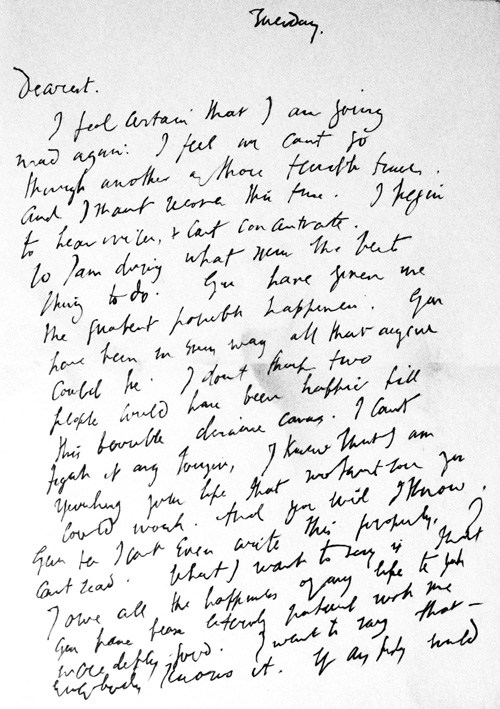
In a blog post about the response in the press to Virginia Woolf's suicide, Brainpickings cites the work of scholar Sybil Oldfield to show how one reader, the wife of the Bishop of Lincoln, misrepresented Woolf's anguished suicide letter as Woolf's cowardly inability to face the suffering others were bravely standing up against in the early years of World War II . This was a moment when the frightening possibility of a German invansion loomed large. To self-righteously judge Woolf for her suicide involved either willfully or unconsciously misreading her words. Even after Leonard wrote an outraged letter to The Sunday Times trying to set the record straight by quoting what Woolf actually wrote and explaining its context, the words were still twisted to label her a war shirking coward. The post, which I can't do justice to in summary, is superb and well worth examining in its entirety. If nothing else, it reminds us to carefully read the words people actually write: 


Woolf's suicide note


Brainpickings sums up the situation as follows:

Above all, however, embedded in the media’s treatment of Virginia’s suicide is a grotesque reminder that the only thing more morally repugnant than passing judgment on another human being’s private struggle and inner world — than choosing self-righteousness over compassionate understanding — is doing so publicly, especially as a currency of tabloidism. What a spectacular failing of the awareness that it’s far more rewarding to understand than to be right. One can only hope this awareness has evolved for us, both as a culture and as individuals, since Woolf’s time.

Unfortunately, the note of optimism that rang out in 2014 has become dimmed. 


An Op-Ed  by Paul Krugman  in The New York Times (https://www.nytimes.com/2019/12/23/opinion/ebenezer-scrooge-trump.html?action=click&module=Opinion&pgtype=Homepagelinked to a piece by Adam Serwer in The Atlantic: The Cruelty is the Point, Oct. 3, 2018:


I find convincing Henry Giroux's argument that we in the U.S. live in a "culture of cruelty" and so read Serwer's article with interest. Serwer moves in it from a recent trip he has made to the Museum of African American History and Culture in Washington, D.C. to the cruelty he argues that Trump's followers feel. He first writes of photos of whites proudly posed by the mutilated bodies of lynched black men:


Their cruelty made them feel good, it made them feel proud, it made them feel happy. And it made them feel closer to one another.

He then moves to Trump’s cruelty and  the cruelty of Kavanaugh and his friend laughing over what Kavanaugh was doing to the frightened Christine Blasey Ford. One of Serwer's chief points is that shared cruelty is a bonding mechanism: 

a vehicle for intimacy through contempt. The white men in the lynching photos are smiling not merely because of what they have done, but because they have done it together.

Serwer goes on to say:

Taking joy in that suffering is more human than most would like to admit. Somewhere on the wide spectrum between adolescent teasing and the smiling white men in the lynching photographs are the Trump supporters whose community is built by rejoicing in the anguish of those they see as unlike them, who have found in their shared cruelty an answer to the loneliness and atomization of modern life.
...
This isn’t incoherent. It reflects a clear principle: Only the president and his allies, his supporters, and their anointed are entitled to the rights and protections of the law, and if necessary, immunity from it. The rest of us are entitled only to cruelty, by their whim. This is how the powerful have ever kept the powerless divided and in their place, and enriched themselves in the process. 
The president’s ability to execute that cruelty through word and deed makes them euphoric. It makes them feel good, it makes them feel proud, it makes them feel happy, it makes them feel united.

Shared cruelty can bond people, either in exaltation or shame. Nevertheless, while he mentions it--"Once malice is embraced as a virtue, it is impossible to contain"--Serwer largely does not emphasize or unpack the underlying moralism that justifies exulting in cruelty.

As Serwer says, joy in suffering (schadenfreude or perhaps sadism) is not what humans like to admit. Therefore, the implicit assumption that underlies the naked pleasure in cruelty is righteousness. Those proudly photographed by the mutilated corpses of lynching victims would most likely say--and believe--that they were celebrating their part in making the community "safe" again from vicious thugs who deserved everything they got. The lynching in question was not an exercise in group sadism, but an exercise in community justice. 

I remember in the run-up to the Iraq war in 2003, when I was a religion reporter, the constant drumbeat of Christian right wing radio (now solidly behind Trump)  self-righteously praying not that the U.S. would have a change of heart and refrain from brutally invading another country, but that the Iraqis would see the error of their ways and humbly repent and beg forgiveness for having offended the United States. The not-too-subtle implication was that that if they did not prostrate themselves and do the impossible, such as depose Sadam Hussein, they "deserved" their fate. It was sad, but they had had their "chance," and if they didn't take it they had to learn a hard lesson.

This same mentality seems to permeate the thinking of Trump's most passionate supporters. While I might see it as sheer cruelty to separate a young child (who had no say in coming to this country) from his or her parents, I have heard people say that this is what the parents "deserve" for coming to this country illegally. It is their own fault for bringing their children here, and they--or their innocent children--have to suffer the consequences. It is not our cruelty to their children but their own. 


However, this self-righteousness, if integral to justifying cruelty, does also morph at times into open cruelty: Mrs. Trump's coat as she visited the immigrant children saying "I don't care, do you?" was openly cruel (however it was spun), as is a mocking "boo-hoo" emoticon of a crying figure that was apparently making the rounds in response to the outcry over separating immigrant children and parents.

Self-righteousness permeates the cruelty mind-set: blacks, women, immigrants, the LBGT ... community, have gotten away with "too much" and have to be stopped.  It is not cruelty to do so, the righteous assert, but righting wrongs: tough love, perhaps.

The largely secular wisdom book of Proverbs in the Bible, like its counterpart in the New Testament book of James, has something to say about righteousness: 

Proverbs 12:10 The righteous care for the needs of their animals, but the kindest acts of the wicked are cruel.

What this rather curious proverb says to me is that the truly righteous take care of those who can't take care of themselves in a straightforward way, but the wicked pretend that cruelty is kindness. 

Moving back to Woolf, while she seldom uses the word self-righteousness in her writing, condemnation of it permeates her thought. As she writes in The Common Reader,  in the essay “Notes on an Elizabethan Play:” "delightful though it is to indulge in righteous indignation" it is perhaps a feeling we want to avoid. (Perhaps the Bishop of Lincoln's wife should have read this essay?)


What becomes perplexing is tension between the need to take a stand at time when the choice between cruelty and kindness has seldom been more starkly laid out and the need not to become a mirror of the self-righteousness that morphs into a cruelty justified because the other side "deserves" it. It is so easy to be self-righteous on the left these days--and yet that stance, as Woolf might point out, is destructive. As the ship's captain warns Crusoe in Tournier's retelling of the Robinson Crusoe story,  Friday, purity, another form of self-righteousness is "the acid of the soul."  

Tournier, author of Friday


We need, at least imho, to keep focused on caring for the needs for others and trying to bring the systemic change that will right the wrongs done, not on retaliation or righteousness. 


Tuesday, December 31, 2019

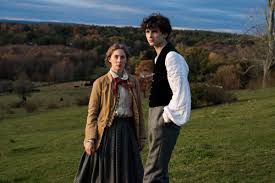
Greta Gerwig's Little Women

I saw the latest Little Women last week and fell in love with it, but was not going to blog about it until I read it criticized for its use of flashbacks. I suppose the film will stand or fall on one's reaction to Gerwig's technique--and those who dislike it are surely held in respect--but I would like to make a defense, first, of Gerwig's flashbacks, and then of the film's larger vision.


As I child, I was given a copy of Little Women with a garish cover, and by the time I was nine, I had fallen in love with the book, in part with wonder at its strange (to me) sentimentalism. I reread it as an adult--my memory is that Roger and I read it aloud as newlyweds--and I reacted to the book in a  different way than as a child. This time I appreciated the deep drenching sadness and loneliness--the bleak depression--Jo faces as an adult when her family of origin breaks apart. It is all loss for her: Meg marries and leaves to begin her own life, Amy travels with Aunt March to Europe, and the lingeringly ill Beth finally dies. Jo stares into a black abyss of desolate loneliness, full of longing for times past, when she had place and companionship. It is as bleak and realistic a portrait as any of what solitary people, male or female, in real life face as props are pulled away. I began to see this as an adult novel--and I think it is no accident that I have been drawn to figures like Austen and Bonhoeffer who faced similar loss.

This bleakness, however, is left out--if I remember correctly--of all the filmed versions I have seen. These cover the basic plot points and the happy marriages (along with the tear-jerking death of Beth) but elide Jo's internal anguish.


By using a flashback technique, Gerwig is able to incorporate Jo's suffering into the plot. The plot moves back and forth between the losses of the "present day," and the jolly days when the girls were all at home together. We encounter Jo, full of the confidence of youth and still surrounded by family, able to tell Laurie the truth: that she can't love him the way he wants. Later, with Beth dead and the house empty of sisters and laughter, Jo is broken, and marriage with Laurie, even if she doesn't love him, seems better than the heartbreaking, soul-killing alternative of loneliness, as she tells her mother. She puts a letter to Laurie, soon to return from Europe, in the knothole of a tree, telling him she will marry him--only to have to retrieve when he returns with Amy as his bride.  This loneliness is central to the story Gerwig has to tell.

Gerwig is also able to avoid what I call the Hamlet problem through the flashbacks--in staging a story so iconic and well known, that has been "done" so many times, how do you avoid going through the predictable paces that cover the familiar episode set-pieces in a stale and predictable way? How do you keep it fresh? Flashbacks are Gerwig's answer--and I felt she handled them expertly.

On a deeper and broader level, I appreciated the humane vision that animated the film. It was beautiful in terms of costumes and settings, but also in terms of articulating generous and compassionate values. I loved, for example, the moment when Jo is urging Meg, more than half seriously, to run away with her rather than marry John Brooke. Meg says to her sister that they are different. The freedom and career Jo centrally hungers for is not the same as the love and domesticity Meg craves. Meg wants what she wants with the same fervor as Jo, and she tells her sister that both goals are worthy. One goal is not better than the other. One goal doesn't have to win, shriveling the other. One sister doesn't have to sacrifice her dreams for the other. The dreams can both coexist and both be good. I have never heard a better or a gentler rejoinder to the "Mommy Wars." Or a better rejoinder to triumphalism and hierarchy: Meg tells us we can all live and pursue our paths side by side and equally, and the world is richer for it. Meg is unthreatened by Jo's ambitions--and in the end Jo is unthreatened by Meg's. This is a world--fantasia though it might be at the present moment--that I would love to live in.


Gerwig also shows the four sisters as markedly different people and illustrates that all forms of being are acceptable. No one is judged. Meg wants husband and family: that is good and worthy. Jo is ambitious to become a published writer: ambition is good and worthy. Beth is a creative soul who wants to pursue the music she loves without any ambition to perform publicly or make a name for herself: that is good and worthy. Amy--an enormously well realized character in this film--wants material well-being because she knows what poverty and worry is: that is good and worthy. All of these woman achieve their goals--and all do so without selling their souls. They all love each other: whatever each one is is fine, and they don't have to be the same.

In this light, I loved Gerwig's handling of Professor Bhaer--made a young and attractive German counterpart to Laurie (though much poorer). Since I find the Professor Bhaer of the novel an overbearing, patriarchal jerk who takes it on himself to (very gently of course) to show Jo the folly of her ways as if she is silly child--judging her and finding her wanting--I derived intense satisfaction when Gerwig's Jo let's him have it with no holds barred. You go girl, as they say. And in Bhaer's (Frederick in the movie) defense, he did mean well--and Jo ultimately takes his advice.

Gerwig follows the plot of the 1994 movie in merging Jo the character with Alcott the author, and in the end, this Jo too pens Little Women--and the marriage with Bhaer is depicted as existing only in the fantasyland of literature. Gerwig's Jo stays, like Alcott, stubbornly single, showing the single path as another viable option for a woman.

The movie has been criticized for excising the Christian theme that structures events in the novel around Bunyan's Pilgrim's Progress, a book each girl receives early on as her sole Christmas gift. I noticed that and saw it as a reworking or even distortion of the book, but in today's political climate, with so much of evangelical Christianity prostrated to violent authoritarianism, Gerwig at least has avoided muddying her message or being co-opted into something she is not.


Men are peripheral in this novel, despite Meg's love of John, and Laurie's important part in the girls' lives. The women live their lives on their own terms, pursuing their own dreams. It was quite refreshing to me, coming after so many films that still--even in the second decade of the twenty-first century--exalt the great man surrounded by female handmaids ready to sacrifice their being for him and put up with his rages, moods, and betrayals--Phantom Threads jumps to mind--there are so many others, and we are prompted to receive them as great cinema, repugnant as they are. Some men may not like this movie, as no woman is ever a handmaiden--not even Meg to John. But it is a movie men can learn from. If our grand leader could understand its compassionate core, the world would be a different place.

Finally, it is the compassionate core that matters. The folding in of pain and suffering that Gerwig is able to achieve through her flashback technique is integral to not sentimentalizing her vision. This is a work of sentiment, but it is not sentimental in a false way that erases pain: Jo, for example, cries in anguish after she sells her hair.

There is so much more to say--and the film is not without its minor flaws and rubs but this is a defense--and I will end here. The costumes, settings, beauty, and female energy animating the movie are breathtaking. The compassion and affirmation of woman, of equality, of space for different kinds of lives to coexist without rancor or violence, should receive our strongest support as a vision of a world where we can all have life, fulfillment and hope without having to tear each other down.

I have not yet read a review, blog, or interview about this movie, though I am aware Amy's character has been praised and that the film has been overlooked for awards. Perhaps now that I have written about it from my own heart I will look at what others--including Gerwig--have to say. 

Tuesday, December 10, 2019

Cries of anguish in Orwell, Steinbeck, and Flannery O'Connor

In John Steinbeck's  Of Mice and Men, the mentally handicapped Lennie, a migrant farm worker, accidentally kills a young woman. Realizing what has done, he runs away to the natural pool by the Salinas River outside of the ranch.  His best friend George instructed him to do this if he ever got in trouble. At the pool, Lennie hallucinates seeing a giant rabbit who berates him and tells him he will be forever rejected by George for what he has done. In response, the tormented Lennie makes an anguished cry:

"Oh! George-George-George!"


In George Orwell's  1984, Winston falls in love with Julia, and this love helps him regain his humanity. After both are arrested and separated, Winston wakes in the middle of the night in his prison cell, crying out in his sleep:

‘Julia! Julia! Julia, my love! Julia!’

In Flannery O'Connor's "A Good Man in Hard to Find," the grandmother realizes her son has been killed:

there were two more shots and the grandmother raised her head like a parched old turkey hen crying for water and called, "Bailey Boy, Bailey Boy!" as if her heart would break. 

Each of these cris-de-coeur pierces through the pages of the text and directly into the heart of the reader. In writers given to understatement, these anguished exclamations of a single repeated name arrest us. We already know that Julia is the center of Winston's universe and George the center of Lennie's. In her hollow, anguished cry, we learn who the grandmother loves before all others.


In all of these narratives, the situations are dire. Winston and Julia are being tortured by a despotic, sociopathic state, Lennie has committed a murder, and the grandmother is responsible for the death of her son and his family--and is facing her own demise. The cries reveal the rawness of emotion when everything is stripped away but the desire for the absent beloved.

In 1984, explanation follows this raw, anguished utterance:

For a moment he [Winston] had had an overwhelming hallucination of her presence. She had seemed to be not merely with him, but inside him. It was as though she had got into the texture of his skin. In that moment he had loved her far more than he had ever done when they were together and free. Also he knew that somewhere or other she was still alive and needed his help.

In Of Mice and Men, as if to relieve an unbearable loneliness and pain, George immediately appears:

George came quietly out the brush and the rabbit scuttled back into Lennie's brain. 

George comforts Lennie--before killing him to save him from a worse fate.

In "A Good Man," the Misfit, the sociopath whose gang is killing the grandmother's family as he speaks, keeps on calmly talking as if the grandmother has not spoken, oblivious to her broken heart.

All three scenes have a hallucinatory quality. In Steinbeck and Orwell it is made explicit, while in O'Connor it is implied when the grandmother mistakes the Misfit for her own son and reaches out to him in love.

It seems striking to me to see this same technique employed by three writers, in works published in a twenty-year period between 1939 and 1958. I tried to remember any other instance of such an anguished call out and could only come up with only two others:

In the first, David hears that his rebellious but beloved son Absalom has been killed. He cries:

O my son Absalom, my son, my son Absalom! Would God I had died for thee, O Absalom, my son, my son! 
This theme has apparently been with me for a long time, as I remember listening over and over to what I believe was Heinrich Schütz's "Fili Mi Absalon" (though in my memory the singing was much more anguished) as a college freshman for a music course and being so moved by David's suffering that I bought a Bible to look up the story. I still have the Bible.

Finally, I thought of another anguished soul in a dire situation:

My God, my God, why has thou forsaken me!

This cry shows that for all his love of his friends, Jesus' first love was God.

I am trying to think of such cry-outs in other pieces of literature. Can you think of any? I can't remember a point in Jane Austen when she breaks her cool demeanor, so admired by Virginia Woolf, to let a direct cry come through, though we feel Elinor's anguish when she thinks Edward has married Lucy and Fanny's as she awaits the letter telling her that Edmund is engaged to Mary. This anguish is no less intense but not given to us in the same form.

Who would we each call out to at the moment of rawest anguish?

Wednesday, June 19, 2019

Swastika Night, violence, Orwell, and style

I will finish Katherine Burdekin's Swastika Night with one last blog that encompasses its attitude on violence, its influence on Orwell, and its writing style.


Burdekin was a pacifist until the start of World War II, when she supported the war because she thought it was vitally imperative to stop the Nazis. As her novel shows, she understood their core, and she despised it.

The novel has three main characters, all men (we remember that women have been reduced to little more than animals). First, Hermann, a typical Nazi, who is very stupid, brainwashed, and violent. Second, Alfred,  who is an English mechanic visiting Germany. He is one of the last true humans on earth, meaning he owns his own soul. Third is a Nazi Knight, von Hess, so high up in the hierarchy he can take risks. He has a special book which contains some of the true story of the earth's pre-Nazi past.  Although admirable characters in the context of the idiocy of the thousand year Reich, both Alfred and von Hess have been brainwashed into believing in woman's inferiority, and von Hess is  comfortable with casual violence, for example, wanting Alfred, while flying an airplane, to simply knock down the  people on the runway, which Alfred refuses to do.

Hermann believes in "the fundamental immutable laws of Hitler Society:"
As a woman is above a worm,
So is a man above a woman.
As a woman is above a worm,
So is a worm above a Christian.
This laughable hierarchy sanctions violence. Not much is going to happen to you (in most cases)  if you take out your aggressions on someone below you. Given that the state also valorizes and applauds violence as the chief attribute of hyper-masculinized manhood, aggressive brutality is common.

Hermann, who has a pathetic and homoerotic attraction to Alfred, is wedded to violence. In a novel in which Burdekin despises Nazism so much she makes it largely infantile and idiotic rather than frightening, she doesn't hold back from depicting graphic violence: this part of the picture is not, to her, ridiculous and needs to be shown.

Infantile Teutonic idiocy that Burdekin despised


For example Hermann gets into trouble when he comes across a fourteen year old, for whom, along with his attachment to Alfred, he has a homo-erotic desire. This boy is an:

angel-faced golden-haired chorister making a determined attempt to rape a well-grown little girl of about twelve. The child had not reached the age of submission and was therefore within her rights in putting up a sturdy resistance. And as Hermann stood for an instant, watching them rolling and tumbling, clawing, kicking and biting, he caught sight of a large red cross on the breast of the little girl’s jacket. So it was a Christian! Hermann’s whole body filled with delicious thundering warming floods of rage. He loathed the boy for being even interested in girls—with his lovely face, his ... immaturity—Hermann was physically jealous; he was shamed ... here was something at last that he could smash and tear and make bleed and utterly destroy  ...Hermann jumped at him again, and with his fists beat him into insensibility. He took special pleasure in spoiling his face. When the boy was lying unconscious at his feet he started to kick him, in the ribs, on the head, anywhere ...

The above accurately captures the Nazi mindset.

Against this, Burdekin makes a plea for non-violence. For instance, von Hess has grown up saturated in a violent culture, but he says the following to Alfred:

And warn them, warn them, Alfred, with all the soul-force you have, against violence. I don’t mean telling them just not to kick physically against the German authority, I mean warn them against accepting violence as a noble, manly thing. We Germans have done that, we have brought force to its highest power, and we have failed to make life good ...

Over and against the mindless hierarchy and cult of masculinity that sanction violence, Burdekin argues for British-style liberalism:


that very tolerance of sincerity in ideas which oneself finds loathsome shows a reserve of spiritual power which I cannot help envying for our people. In these English and Scotch heretics of all ages and in the common men who could not withhold from them all sympathy, England’s real greatness lay. If they can resist, not the physical destruction of their records, for that will be impossible, but the Germanisation of their character, and somehow, in face of all the deception they will suffer, remain themselves, there will be soul-power in Europe after the passing of this dark evil time. 

These are still words for our time.

It seems clear, as others have pointed out, that Orwell must have read and been influenced by Burdekin's novel as he wrote 1984,  which is focused on an English Everyman like Alfred who goes up agains the power of a vicious and violent totalitarian state that robs people of their humanity.  His novel also features a secret book that lays bare the underpinnings of the social order.

Of course, we read 1984 for a reason beyond polemic: it is good literature (I realize, too,  it is sexist--and ageist). In contrast, as far as the quality of writing goes, Burdekin is crude. She is far less interested in style than ideas. I went back to the novel thinking perhaps I was too harsh, perhaps it doesn't read like the draft, but then came across the first line:

THE Knight turned towards the Holy Hitler chapel which in the orientation of this church lay in the western arm of the Swastika, and with the customary loud impressive chords on the organ and a long roll on the sacred drums, the Creed began.

I stumbled over "customary loud impressive chords" but then thought, well, maybe it is not too bad. There's description and some alliteration ... it's not much worse than du Maurier's Rebecca or some of Agatha Christie's mysteries, but it has an even rawer quality, as if the novel itself were the barest skeleton on which she displayed her ideas: the characters are not fleshed out, nor is the story. It has the quality of something filmed on little more than a bare stage. For example, there are pages of sheer dialogue without one mention of someone moving a limb or even having a body. 

Nevertheless, there's also a certain crude power in her stripped-down writing: the ideas don't get buried under story, and there is little ambiguity about her point. 

I am glad I read this novel. Burdekin saw through early to the core horror of fascism--an atavastic, violent pseudo-philosophy. As Thomas Wolfe expressed in You Can't Go Home Again,  a book about his trip to Nazi Germany in 1936, these crude ideologies do not die but merely crawl into caves and crevices to await their time (Camus's observation as well in The Plague)) to reemerge. We are in that time again.  Burdekin, who speaks with incisively for woman's rights, peace, dignity. freedom of thought, and human decency, thus speaks to us today.  


Tuesday, June 18, 2019

Swastika Night and Women

Katherine Burdekin largely wrote fantasy or speculative fiction. She graduated from Cheltenham Ladies' College. As Martha Vicinus points out in Independent Women: Work and Community for Single Women, attending that particular boarding school signaled that a young woman ranked high on the class ladder. Tradesman's daughters could not get entrance, no matter how rich. Attending meant something, as going to Eton did. In Burdekin's case, her education served her--and us-- well. 

Cheltenham Ladies' College: Begun in the nineteenth century, it was built in a Gothic style.

Burdekin was highly intelligent and wished to attend Oxford, which by that point had woman's colleges, but her father would not allow it. She married, went to Australia, had  two daughters, and fairly quickly left her husband, moving back to England in 1823. She lived with her sister in Minack Head, Cornwall, until meeting and setting up housekeeping nearby with a female partner in 1926. Great credit goes to scholar Daphne Patai for unearthing Burdekin's identity and doing research on her very private life. 

Katherine Burdekin


Burdekin knew the Woolfs but was not part of their circle. Her politics and theirs, however, were similar. 

Clearly a student of Nazi rhetoric, in a literature more available in the 1930s than now, Burdekin picked up on the ridiculous romanticizing of the Nazi soldier as Teutonic Knight. She also zoomed in on Hitler's claim that his would be a thousand-year reich. In her novel, Germany has achieved partial world domination: the planet is divided between the Nazis and a far-flung Japanese Empire. All of Europe is firmly in Nazi hands.

The story begins 700 years into the thousand-year Reich. Although told from a male point of view, it soon turns to the women. In a parody of Hitler's desire to put females back in the home solely to serve as the breeders of his hyper-masculine soldier elite, Burdekin exaggerates the subjection of Nazi women. The women we encounter in Germany--and who are representative now of women across Europe--are small, ugly, stupid, degenerated, and illiterate. Their heads are shaven, and they are kept herded in barbed-wire camps, a clear allusion to the already flourishing Nazi concentration camps. Women are incessantly taught that their life's purpose is to align their wills with male wills, to obey men, and to have male babies. 

There is no rape, because rape would presuppose a woman having a mind of her own. Instead a woman who is raped must quickly understand that because a man wanted to rape her, she must have wanted the rape as well. After all, his desires are necessarily her desires. All of this is explained with dead-pan seriousness. Male babies are taken from the women at 18 months, before they can have any memories of their mothers, so that they can be brought up in a wholly masculine environment and not be polluted by exposure to the female. This is another exaggeration of Nazi policy.

Soon after the novel opens, women are herded into a Nazi "church," shaped like a swastika, for their monthly indoctrination visit. Hitler is now worshipped as a god, depicted as seven feet tall with golden hair and a golden beard. He is said to have "exploded" from the head of God the Thunderer and so never was in any way polluted by contact with a woman.

This particular edition shows Hitler reimagined as a blond Norse God. As can be seen, Burdekin published under a male pen name.


The woman cry in the church. The men think this arises from fear of being in a male domain, but as we later learn, it comes from an ancestral, barely understood mourning for all they have lost. 

Burdekin says that women are partly responsible for their fate in this new world, because for far too long they made it their goal to align with male desire.  In words that are relevant to today's world, the narrative clearly and cogently summarizes women's problems:

There are two things women have never had which men have had, of a developing and encouraging nature. One is sexual invulnerability and the other is pride in their sex, which is the humblest boy’s birthright. And yet, until they can get back those two things, which they lost when they committed their crime and accepted men’s idea of their inferiority, they can never develop their little remaining spark of self-hood and life.

Further, the text posits that what is missing from women is

 a soulpower which would come from being themselves, from being women. Men would never want to force them [rape them, if women had soulpower]. It would be unthinkable, impossible.

Burdekin is not afraid to imagine a female subjugation in which male society is entirely homosocial and homoerotic, as well as hyper-masculinized. Homosexuality is tolerated, as who can men love, respect, and think beautiful but other men? Woman are far too degraded. They are animals to rape and impregnate.

The book does not do well in terms of language respecting animals, though I can't imagine a person as humane in outlook as Burdekin meaning to denigrate or call down harm on other living creatures. However, her tendency to describe women as little less than beasts, dogs, or livestock tends to rob animals of their dignity.

In a comic touch, the women are told they have to bear more girl babies. They are not told why, but we learn it is because they have so wholly aligned themselves with male desire that they are having far too many male babies for the human race to continue. More women are needed as breeding material. However, the women are so full of self loathing that they simply decide they must have misheard the directive. 

There's little plot to spoil, but  I'd like to go back to Burdekin's analysis of the plight of women. Then in my next blog I will discuss other aspects of the novel, such as violence, its influence on 1984, and its writing style.

Burdekin's women of the Nazi future are almost comically oppressed. But how much is it exaggeration, and how much is it underlying reality, with the veil ripped off, of our times?  Three works of literature happened to run in front of me recently that illustrate Burdekin is not much exaggerating. The first is Bret Harte's "The Luck of the Roaring Camp." In this story's roaring camp, there is but one woman, Cherokee Sal, whose name suggests a mixed race. She is a prostitute who gets pregnant and gives birth to an infant boy. Of her death, we learn this:

Within an hour she had climbed, as it were, that rugged road that led to the stars, and so passed out of Roaring Camp, its sin and shame forever. I do not think that the announcement disturbed them much, except in speculation as to the fate of the child.
"The Luck of the Roaring Camp:" Who needs women when we have men? 

Getting rid of the sole woman--creating an all male environment like that of Burdekin's Nazi empire--eradicates "sin and shame forever" from this camp of vagabonds and thieves! (This eradication is supposedly of sexual sin, but read the words!) Women is the sole problem! Of course, they are not much bothered by her death: was she even human to them? But in this newly liberated all male world, the little boy can flourish from birth without the polluting influence of a woman. Women's insignificance is further emphasized by this: Stumpy and his ass, who feeds the child her milk, are all it takes to raise the child:

 “Me and that ass,” he would say, “has been father and mother to him!"

That quote is particularly striking. We may condemn Burdekin for equating her women to animals, but it is a common trope. An ass can do as well at parenting as a woman. What also strikes me is that I was read this story in elementary school (no doubt in some bowdlerized version) as an amusing piece of folktale Americana. The misogyny was completely lost on me, as on my female teacher--and so it is passed on, like a virus we can't see. (Of course, the child Luck does die--so perhaps they did need a woman?)

The second work is Daphne du Maurier's Rebecca, a book my mother gave when I was 12, as she thought I would enjoy it as much as she did. Since I figured out the twist early on, I didn't, but I did imbibe another dose of misogyny, this is form of a woman abasing herself and abandoning her moral compass to wrap herself around and stand by her man. Her husband Max's confession that he is a murderer who shot his first wife, Rebecca, through the heart, does not horrify her, but brings them closer! Why? Because it means she can have his love! He really didn't love Rebecca! And not only does it occur to her that she has only his side of the story, of course told to make himself look like the victim, but she is vigorously in favor of erasing Rebecca's story and truth itself in defense of patriarchy: 

 Rebecca is dead. She can't speak, she can't bear witness.

In a morally coherent world, that might be a problem. But not here. Rebecca annoyed--dared to assert equal power to her husband as well as bodily autonomy--so she deserves to die.  Rather than be concerned that this man--monster??--she has married killed another woman for taunting him about bearing another man's child (think about that--and the murder is justified as commensurate to Rebecca's "evil!")--the new wife wants to cover up the murder:

Nobody saw you that night. You had  gone to bed. They can't prove anything. 

 This woman, as much as any abject shaven headed woman in Swastika Night, has been brainwashed to support a violent patriarchy in which a man is justified in killing an uppity woman--and as his new woman, the wife aligns herself immediately and unquestioningly to defend him, even though he is guilty. I was given this at an impressionable age as a great romance novel.

Finally, for the first time, I read a long short story by Harold Brodkey called "Innocence." A more recent work, it still illustrates the extent to which women have been deformed by a desire to please and serve men. It is told entirely from a male point of view, in first person, and is about a male, a college student, bringing a beautiful young woman to her first orgasm. She has already had sex--she is not virgin territory, but she has never enjoyed sex before. This man therefore has the opportunity to lay claim to dominance over her body by being the first to offer her true sexual satisfaction. He can master her that way. And while we might say it is thoughtful of him to be so concerned about her orgasm, it is clearly in service of his own ego needs. But that is almost beside the point. What is striking is the pathetic abjection and abasement of the woman who comes to his room. At first she says "damn" when she realizes he is naked under his sheet and wants sex, then immediately  and compliantly begins to unbutton her blouse. The narrator says:

I was amazed that she was so docile; and then I saw that is was maybe partly that she didn't want to risk saying no to me--she didn't want me to be hurt and difficult, she didn't want me to explode; she had a kind of hope of making me happy so that I'd then appreciate her and be happy with her and let her know me

Compare the above to Burdekin's quote: What men have and women lack

 is pride in their sex, which is the humblest boy’s birthright. And yet, until they can get back [what] ... they lost when they committed their crime and accepted men’s idea of their inferiority, they can never develop their little remaining spark of self-hood and life.

Burdekin exactly, in Swastika Night, exactly describes the woman Brodkey describes. As with all dystopia, we are in the present moment--or were until very recently.

 Burdekin says that to achieve equality women need to first, learn to love themselves as themselves, fully as women, not as appendages of men or as inferior men or wannabe men or men pleasers. One could argue that in our society, many women (certainly not all), are coming closer to that ideal. #Metoo showed that many women are no longer identifying with the aggressor or making excuses for predatory and unwelcome male behavior. Women are no longer keeping silent or accepting the male overwriting of our experience. This is fueling a backlash, as some men--as with Dr. Ford's allegations about Kavanaugh--take the gloves off and say they don't care. It's stunning that Republican congressmen could both say they believe Dr. Ford, and yet dismiss her testimony as not mattering when it came to a decision about a Supreme Court appointment. One wonders what will happen, as patriarchy is premised on a trade-off--women give up certain rights to men in return for protection. If men are openly abdicating on that protection, why should women relinquish power to them?

This leads to Burdekin's second point. The other attribute women have never had that men do is  "is sexual invulnerability." We are still subject to control through rape and impregnation--and in some parts of the world through genital mutilation.  Prostitution is another component of this vulnerability. Burdekin implies we can get beyond this if we develop our integrity as women. If we come across as and are fully accepted as equals, men won't think of raping and violating us. This may or may not be true, but at this time in history, it seems as if men, losing control of women as they more own their womanhood, may be doubling down on bodily control. This domination is threatened through denial of birth control and abortion laws that have far more to do with controlling women's bodies than caring for infant lives. Whether this is a rearguard action in a lost cause is yet to be seen.

And complicating all this is that in our society and the future Nazi empire, men's bodies are also vulnerable.  But more next time. 

&&&&


Monday, June 17, 2019

Physical reading experiences and Swastika Night I

A recent thread that I continue to ponder concerns reading physical books. Having been reading e-books through Kindle for more than a decade and Gutenberg on-line volumes even longer--and of course physical books for decades--I now feel able to comment on both modes, electronic and print. I will first say I greatly appreciate e-books when I am doing research: it was a huge timesaver for me to be able to cut and paste quotes for my Bonhoeffer book, and this feature continues to be a boon. I also find it a lifesaver to load books onto my i-Pad for oversea flights and adventures. Further, I don't find much difference in the actual reading of a book one way or another, though I still find it harder to "curl up" with my Kindle.

Katherine Burdekin published this under the pen name Murray Constantine. She was a very private person, like Elena Ferrante. 


Nevertheless, after ten years, I do find I prefer hard copies to e-books. I am not happy or nostalgic or sentimental about this, as life would be easier--and reading easier on our global environment for a vast number of reasons-- if I (and others) could keep our library of volumes on a space no large than one single slim hardbound book. I find, however, that physicality matters. I am always forgetting the books I have in my Kindle library. It is as if they don't exist. This can lead to  a sense of not having read them and a tendency not to return to them. I find this phenomenon perplexing but real. Further, I derive happiness from looking at my shelves of real books that an e-book to date has not been able to replicate. I recognize my personal happiness is not the most important factor in the universe, but I mention it because it is part of my relationship to books.

All of this is a roundabout way of backing into my real subject, which is Katherine Burdekin's 1937 novel Swastika Night. I will get to the matter--the thought and prose--of the book itself soon, but I  want to continue to dwell in and on reading's great surround. Recently, I read an op-ed piece in The New York Times that argued we need to take the time to read books in one sitting or in long sittings. As one who in recent years, pulled in a multitude of directions, has taken to reading books in short bits over longish periods of time, this op-ed struck a chord. The books I remember liking best, those that stick with me, I've read in big chunks, such as on a plane to England. I have come to recognize that something important is lost, no matter the book's format, in the chopped-up reading session. This factor makes group reads online a problem--a book deserves to be read--and understood--as a whole. Therefore, I pushed myself to read Swastika Night in two sittings (it is short) and am glad I did.

The novel was put out by the Left Book club in 1940, during World War II. The Left Book club also reprinted Orwell.


 I also have been thinking about book historians, those people who study the physical production and appearance of books. How a book looks matter. I was delighted, for example, to learn--an idea that must have much captured Tolkien's fancy--that William Morris in his 1896 The Well at the World's End, imagined a book that could only be read when put on a particular stone in a particular forest. I wonder, therefore, if reading Swastika Night on-line, in a version that went margin to margin and looked somewhat more typed than like a real printed book,  dampened my experience of it? Does the joy of reading the novel in a brief span of time balance the marginal quality of the format in which I read it?

 I had tried (not very actively) to read Swastika Night once before, during my Bonhoeffer research. and had utterly forgotten it existed. A talk on Woolf's Three Guineas and utopias at a recent Woolf conference reminded me of it, as it was part of the conversation (utopias inevitably lead to dystopias). I decided to force myself to plunge in a second time.

Swastika Night reminds me of Candide in being a hybrid of novelist features and polemic, and in its use of exaggeration, satire, and very dark humor, though Candide is more laugh-out-loud funny in its over-the-top hyperbole, leaving you laughing and crying at the same time at the horrors the characters undergo.  Swastika Night uses, as well, naive narrators who unthinkingly--or partially unthinkingly--accept the social order. As a disclaimer, however,  it only shares certain similarities with Candide: in many ways the two books are very different. It is also prescient in envisioning, in 1937, a world war fought and won by the Nazis. But this blog is long enough and more on the novel's content will follow in a second blog.


Thursday, January 17, 2019

Xenofeminism, Virgina Woolf, and cruft

Modern feminism seems to me to have lost its bearings. How do we bring it back?

I recently read a document called "Xenofeminism: A Politics for Alienation" by a collective of six women who call themselves Laboria Cubonik. As is typical of how my mind works, I immediately began calling it "The Xenofeminist Manifesto"--and it is a manifesto.

Imagery is important to conveying the message of a movement. These colors are bold and rainbow-like in a technological way, but don't give me much to grasp--and maybe that is the point. 


 Xeno means "foreign," and the essay calls for a foreign or "alien" feminism.  It emphasizes three ideas: technomaterialism, the idea that we can use technology to make life better for average people; anti-naturalism (a rejection of nature); and gender abolition, which the essay states doesn't mean that gender doesn't exist or that we should give up gendered traits, but that these traits shouldn't matter. Gender abolition also includes a call for an end to racism. 

The manifesto, as I will call it, is highly abstract. This, presumably, is because it is trying to get to the core of its issues and shed "cruft." "Cruft" was one of the many words in the essay I had to look up. Cruft means "anything that is left over, redundant and getting in the way. ... meant in the sense of 'detritus, that which needs to be swept up and thrown out.'" 

The "XF" writers speak of cyberspace as filled with the "noisy clutter of commodified cruft." I appreciate the alliterative "c" words in that phrase, but also note that cruft is assigned, both in the definition and the essay, a negative connotation--and the word itself sounds unpleasant.


I am working on a writing project on what might be called "cruft"--on marginalized single women who were considered unneeded. Many were erased and have largely disappeared from history. These women were called redundant and were literally often swept up and tossed, at least in England, to the colonies. Shining a light on these women who did not "fit" to show how they did fit or could have fit or were punished or erased for not fitting the perceived "correct" way is at the heart of feminism and humane living. A humane society has to be built on stories that are as true as we can make them, and including these women is part of that truth. 

As I was reading the manifesto, written, understandably,  with passion and anger despite its emphasis on "rational" feminism, Virginia Woolf popped to mind, particularly her two feminist essays, A Room of One's Own and Three Guineas. They occurred to me as representing the opposite of "Xenofeminism:" an opposite aesthetic and an opposite approach to (possibly) similar perceptions of the need for gender emancipation, social justice, and anti-consumerism. Both the Xenofeminists and Woolf seem to be in pursuit the same goal (I think): a humane social order, though I do have profound doubts about XF methods.

If the Xenofeminists are concerned with excising the cruft, cruft is the core of Woolf's business--and at risk of sounding Derridean, I would argue that cruft--that which is considered "redundant and getting in the way"-- is central to a humane literature and a humane society. 

One of my problems with the manifesto is that it seems to me difficult to build a humane society on the basis of a type of essay so abstract. It is also inaccessible to the average person, full of an insider jargon that the ordinary reader simply is not going to understand. Words I had to look up included, beyond cruft and xeno, morcellation, memetics, hyperstition, and negentropic. In using such words, the essay seemed to me to be replicating the corporate model they dislike: offloading the work to the consumer. The manifesto may be brief and cruftless, but is so by forcing the reader to do the extra footwork of deciphering meaning. Is a humane society not built, in part, on making idea accessible to ordinary people: not dumbing them down, but presenting them in a graspable way?  This is what Orwell does, and what Woolf does to. There is a reason "a room of one's own," a phrase anyone can understand, is part of the modern vocabulary. 

There is a warrior quality to the prose: seized, weapons exorcised. What we don't want is a feminism that replicates the worst of the patriarchal state. 


Some have complained to me, however,  about the meandering quality of A Room of One's Own: why is it so longwinded, what is the point, they ask? In other words, why so much cruft? And arguably, Woolf could have edited it without loosing her point. But it is in the cruft that one comes to see what gender inequality looks like  as it is lived in the mundane particulars of everyday life: it is lamb and good wine at a men's college versus mutton (or in U.S/ terms, meatloaf) and water at the women's college. It is  having access to a good library or being barred from it. In these details  a life is made. These are the details that  we observe exactly only we take the time and space to meander. In these details a stunningly persuasive argument is built. 


The Xenofeminists would no doubt argue, and to some extent, rightly, that it would take writing books to lay out the particulars of their agenda, but is that so? Could this not also be done in the "tweetable paragraph" format of the manifesto? A story, I understand, can be told compellingly in 56 words. And if it takes more time, isn't important to find that time? If I understand what is behind the XF abstraction, it is, in part, allowing people leisure time: the kind of slow time that allows people not to rely on tweets. 
We can't build a humane society without a humane literature (in which I include filmed media), and a humane literature, I argue, rests on the particular and the domestic. XF rejects the domestic--and this sense has much in common with the Leninism of the early Russian Revolutionary period, but how can we expect to embrace a reinvented domesticity if we don't know what this is like? Leninism at least tried to articulate what the new domesticity would be.

My overall problem is that I don't know what FX's reinvented social structure looks like, and I fear that the cruft they will discard is exactly the cruft that makes life worth living.  What do they mean when they say they want "superior forms of corruption?" Or as Ellen Moody asks, what risks, exactly, do they want us to take? 

A review of XF uses this an image. She is Xena, a warrior woman, and her name is here associated with Xenofeminism. Whether this is a false appropriation or not, the word xeno is close enough to Xena for the association to make sense. If this is an image the Xfers would approve, I am very much out: this is exactly not what feminism needs. If this is the way the tern is being deployed, the XFers should, imo, be vigorously resisting this --and perhaps they are. 

Ultimately, I am uncomfortable with the totalizing abstractions of the XF essay. I want to know what all of this looks, feels, sounds and tastes like. I think of Stalin's dictum: "The death of one person is a tragedy, the death of million people is a statistic." Give us, XFers, the life one person in the remade universe.