Showing posts with label film. Show all posts

Sunday, February 9, 2020

Parasite: Some thoughts on class

I recently saw the Korean film Parasite, directed by Bong Joon-ho, which features a sewage flood, and in one of those serendipities that often happens, a few days later, our toilet overflowed in what seemed an endless cascade of water that flooded our bathroom. The water was about a quarter inch deep, flowed into the hallway and even into the bedroom across the hall, then  leaked volumes into our basement. It was a mess, and even if at a much smaller scale, eerily similar to the raw sewage flood that goes shoulder high through the basement apartment of the poor lead family in Parasite.

The upshot of our personal contretemps with a flood of overflowing toilet water was exhaustion. I cleaned myself up and went to yoga, too tired to make the dinner I had planned. Roger, a valiant water battler, and Nick went to Subway.

This illuminates the logic of the poor family in the movie. The main poor characters almost always seem to eat out. I am aware, living in Barnesville, that an acute part of the class divide here is summed up in who cooks in--makes "real" meals--and who relies on fast food and junk food. Not making home cooked meals is looked down upon as a mark of being lower class.

Parasite captures that: When our poor protagonist family earns some cash folding pizza boxes in their apartment, we next see them in a fast food type joint drinking sodas and eating bags of chips. Later, when the adult son and daughter land tutoring positions with a rich family, the first thing the foursome (including the parents do) is go to a cheap fast food buffet where they pile their plates high with food.
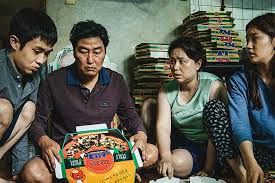
Folding boxes in their cluttered basement apartment

 The day after the unfortunate flood, the bathroom rugs duly washed, dried, fluffed and returned to the bathroom floor, I did make my planned meal of mushroom stroganoff, and as I did  I ruminated on how emblematic my easy ability to do so is of class position: how can this seemingly simple task be possible for people living in precarity?

I could make a stroganoff because I am not working on my feet all day or dealing with irate customers or facing a harrowing commute home, all of which easily leaves one too spent and exhausted to cook a complicated meal. I have also lived in the same home, with plenty of room and a large kitchen, for 11 years: therefore, I have all I need to cook at hand--thyme and worcestershire sauce in the cupboard, flour, butter, fresh mushrooms, onions, garlic, wine, organic vegetable broth. These are expensive and time consuming to gather all at once--for such cooking to be possible, such items have to be part of the normal flow of life, along with a full array of cooking utensils--measuring cups, spatulas, wire whisks, pots and pans, strainers, good knives, wooden spoons. And one has to have the energy to clean all this up.

It is easy to see how especially the mother in Parasite might not want to come home and cook and clean up after cooking and caring for another family all day. It is easy to see how the family, living precariously and in a home that might be prone to flooding, might not accumulate the necessary items to put together a home cooked meal even if they somehow could muster the energy.

Who can judge them for eating out?

Happily eating out:food is good when you have been hungry


The movie is a twist on the 1970s series Upstairs/Downstairs: as I was watching the poor family, who all insinuate themselves into employment as servants,  take advantage of the rich family's camping trip to bath in their tubs, eat their food, drink their alcohol and sprawl on their furniture, it instantly brought to mind a classic episode of the original series when the servants to do the same, though in their case they primarily dress up in their master's clothes--and drink their alcohol.

Likewise, the idea of the people at the bottom as tricksters who must live by their wits, fooling those at top, is a classic theme--and how often we have seen it in play. Further, when the rich family goes on a camping trip and thunder strikes, we know what is going to happen if they poor family, astonishingly, does not. But then, maybe not--how in touch would a poor urban family be with nature?

What the movie brought home--yet again--is the way poor working people have to efface themselves and be endlessly pleasant, upbeat, and helpful to their employers, who are oblivious to what they are undergoing. I was reminded of an article I read some years ago of Latino nannies in the L.A. area who learned very quickly to tell their would-be employers they had no children, as the employers didn't like the idea that the nannies they employed had loyalties to any children but their own.  This left the nannies not only with children at home, but having to juggle this without their employer's knowledge--a system very weighted to the emotional ease of the employers, who simply were alleviated of having to worry about another person's children, and to the added emotional stress of the nannies, who had to carry any childcare problems without employer support.

The husband in Parasite's rich family talks more than once about maintaining the "line" between the servants, in particular  his driver, the father in the family, and himself. The employer doesn't like servants crossing the "line." On the night the poor family is having a fine time and the storm drives the rich family home early, the rich couple decide to sleep on the living room sofa so they they can watch their son, who is outside inn a teepee. The father of the poor family is hiding under the sofa, and grows increasingly humiliated and enraged as the rich husband talks about him "crossing the line" with his bad smell of radishes. The rich husband reveals how oblivious he is to the challenges the poor family faces simply keeping clean to his standards.

The spacious, gracious uncluttered home of the rich is a contrast to the poor families' dingy, crowded apartment.


A surprise to me was finding out about others living secretly in the rich people's  house, but this shows that the secret lives of the poor have layers upon layers. A key privilege of class is the ability to remain oblivious, but this movie now makes that a little harder to do.

The poor family is not romanticized. They have a hard streak, well hidden (except in the case of the daughter) from the upper class through most of the movie. As an aside,  after watching this movie, Virginia Woolf leapt to mind: her delight in the later 1930s when she bought a piece of technology we all take for granted: a modern gas (or perhaps oil) range in which she could regulate the temperature. This meant she didn't have to incessantly watch whatever was cooking: she could put a cake or a roast in the oven, set the timer, and go back to her writing. This alleviated her of needing to hire a cook, for which she was ecstatic. She, too, talks about the line between servants and masters in her essays: in her case, the willingness of servants to engage with employers about their own lives after World War I was an important sign of social change.

I don't want to give away the ending of the film, but from the film, from Woolf, from so many others, it becomes clear that not needing servants is a boon to everyone involved, perhaps especially the servants themselves--as long as there are other, more productive means of employment, which it seems a wealthy, industrialized country could provide.

Tuesday, December 31, 2019

Greta Gerwig's Little Women

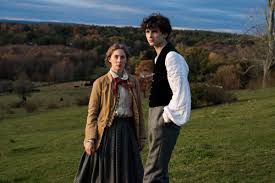
I saw the latest Little Women last week and fell in love with it, but was not going to blog about it until I read it criticized for its use of flashbacks. I suppose the film will stand or fall on one's reaction to Gerwig's technique--and those who dislike it are surely held in respect--but I would like to make a defense, first, of Gerwig's flashbacks, and then of the film's larger vision.


As I child, I was given a copy of Little Women with a garish cover, and by the time I was nine, I had fallen in love with the book, in part with wonder at its strange (to me) sentimentalism. I reread it as an adult--my memory is that Roger and I read it aloud as newlyweds--and I reacted to the book in a  different way than as a child. This time I appreciated the deep drenching sadness and loneliness--the bleak depression--Jo faces as an adult when her family of origin breaks apart. It is all loss for her: Meg marries and leaves to begin her own life, Amy travels with Aunt March to Europe, and the lingeringly ill Beth finally dies. Jo stares into a black abyss of desolate loneliness, full of longing for times past, when she had place and companionship. It is as bleak and realistic a portrait as any of what solitary people, male or female, in real life face as props are pulled away. I began to see this as an adult novel--and I think it is no accident that I have been drawn to figures like Austen and Bonhoeffer who faced similar loss.

This bleakness, however, is left out--if I remember correctly--of all the filmed versions I have seen. These cover the basic plot points and the happy marriages (along with the tear-jerking death of Beth) but elide Jo's internal anguish.


By using a flashback technique, Gerwig is able to incorporate Jo's suffering into the plot. The plot moves back and forth between the losses of the "present day," and the jolly days when the girls were all at home together. We encounter Jo, full of the confidence of youth and still surrounded by family, able to tell Laurie the truth: that she can't love him the way he wants. Later, with Beth dead and the house empty of sisters and laughter, Jo is broken, and marriage with Laurie, even if she doesn't love him, seems better than the heartbreaking, soul-killing alternative of loneliness, as she tells her mother. She puts a letter to Laurie, soon to return from Europe, in the knothole of a tree, telling him she will marry him--only to have to retrieve when he returns with Amy as his bride.  This loneliness is central to the story Gerwig has to tell.

Gerwig is also able to avoid what I call the Hamlet problem through the flashbacks--in staging a story so iconic and well known, that has been "done" so many times, how do you avoid going through the predictable paces that cover the familiar episode set-pieces in a stale and predictable way? How do you keep it fresh? Flashbacks are Gerwig's answer--and I felt she handled them expertly.

On a deeper and broader level, I appreciated the humane vision that animated the film. It was beautiful in terms of costumes and settings, but also in terms of articulating generous and compassionate values. I loved, for example, the moment when Jo is urging Meg, more than half seriously, to run away with her rather than marry John Brooke. Meg says to her sister that they are different. The freedom and career Jo centrally hungers for is not the same as the love and domesticity Meg craves. Meg wants what she wants with the same fervor as Jo, and she tells her sister that both goals are worthy. One goal is not better than the other. One goal doesn't have to win, shriveling the other. One sister doesn't have to sacrifice her dreams for the other. The dreams can both coexist and both be good. I have never heard a better or a gentler rejoinder to the "Mommy Wars." Or a better rejoinder to triumphalism and hierarchy: Meg tells us we can all live and pursue our paths side by side and equally, and the world is richer for it. Meg is unthreatened by Jo's ambitions--and in the end Jo is unthreatened by Meg's. This is a world--fantasia though it might be at the present moment--that I would love to live in.


Gerwig also shows the four sisters as markedly different people and illustrates that all forms of being are acceptable. No one is judged. Meg wants husband and family: that is good and worthy. Jo is ambitious to become a published writer: ambition is good and worthy. Beth is a creative soul who wants to pursue the music she loves without any ambition to perform publicly or make a name for herself: that is good and worthy. Amy--an enormously well realized character in this film--wants material well-being because she knows what poverty and worry is: that is good and worthy. All of these woman achieve their goals--and all do so without selling their souls. They all love each other: whatever each one is is fine, and they don't have to be the same.

In this light, I loved Gerwig's handling of Professor Bhaer--made a young and attractive German counterpart to Laurie (though much poorer). Since I find the Professor Bhaer of the novel an overbearing, patriarchal jerk who takes it on himself to (very gently of course) to show Jo the folly of her ways as if she is silly child--judging her and finding her wanting--I derived intense satisfaction when Gerwig's Jo let's him have it with no holds barred. You go girl, as they say. And in Bhaer's (Frederick in the movie) defense, he did mean well--and Jo ultimately takes his advice.

Gerwig follows the plot of the 1994 movie in merging Jo the character with Alcott the author, and in the end, this Jo too pens Little Women--and the marriage with Bhaer is depicted as existing only in the fantasyland of literature. Gerwig's Jo stays, like Alcott, stubbornly single, showing the single path as another viable option for a woman.

The movie has been criticized for excising the Christian theme that structures events in the novel around Bunyan's Pilgrim's Progress, a book each girl receives early on as her sole Christmas gift. I noticed that and saw it as a reworking or even distortion of the book, but in today's political climate, with so much of evangelical Christianity prostrated to violent authoritarianism, Gerwig at least has avoided muddying her message or being co-opted into something she is not.


Men are peripheral in this novel, despite Meg's love of John, and Laurie's important part in the girls' lives. The women live their lives on their own terms, pursuing their own dreams. It was quite refreshing to me, coming after so many films that still--even in the second decade of the twenty-first century--exalt the great man surrounded by female handmaids ready to sacrifice their being for him and put up with his rages, moods, and betrayals--Phantom Threads jumps to mind--there are so many others, and we are prompted to receive them as great cinema, repugnant as they are. Some men may not like this movie, as no woman is ever a handmaiden--not even Meg to John. But it is a movie men can learn from. If our grand leader could understand its compassionate core, the world would be a different place.

Finally, it is the compassionate core that matters. The folding in of pain and suffering that Gerwig is able to achieve through her flashback technique is integral to not sentimentalizing her vision. This is a work of sentiment, but it is not sentimental in a false way that erases pain: Jo, for example, cries in anguish after she sells her hair.

There is so much more to say--and the film is not without its minor flaws and rubs but this is a defense--and I will end here. The costumes, settings, beauty, and female energy animating the movie are breathtaking. The compassion and affirmation of woman, of equality, of space for different kinds of lives to coexist without rancor or violence, should receive our strongest support as a vision of a world where we can all have life, fulfillment and hope without having to tear each other down.

I have not yet read a review, blog, or interview about this movie, though I am aware Amy's character has been praised and that the film has been overlooked for awards. Perhaps now that I have written about it from my own heart I will look at what others--including Gerwig--have to say.