Saturday, December 5, 2020

Journal of a Plague Year: Best Fiction reads of 2020

 As befits a strange year, my reading patterns deviated from the usual, leaning more heavily into non-fiction and genre literature. Given that a good stand-alone novel is what I love best to sink into, I was sorry not to have read more of these. All that being said, I encountered a wide range of extraordinarily good books. 

Best novels:


Elena Ferrante's The Story of New Name: Some six months after watching the second season of the superb series My Brilliant Friend, I read The Story of a New Name, the second novel in the Neapolitan Quartet.  I had previously read two other Ferrante novels: The Year of Abandonment and My Brilliant Friend. I appreciated both, but neither pulled me wholly into a world the way The Story of a New Name did. Although I had already seen the mini-series that adhered closely to the novel, the novel provided a level of nuance that the series, excellent as it was, flattened. 

If the televised version hovered towards chick lit at times--Lila's romantic frolicking in the waves with the handsome Nino, Lenu's triumphant ending as the successful novelist and scholar who has overcome her impoverished roots--this banality is missing from the pain-saturated novel.  The novel's characters are drawn with nuance--Ferrante never falls into caricature or stereotype. We even feel sympathy at times for the clueless, limited Stefano, despite being appalled at his rapes and beatings of his wife. And while Lila may end up working in a meat packing plant,  unlike in the series, she is never defeated--she, not Lenu, is the true center of the novel.

Ferrante successfully builds and fleshes out the world she began in the first Neapolitan novel. I felt I knew the characters and had a better grasp of the complex community dynamics. I found myself comparing it to some of the more episodic, experimental novels I read this year, such as Overstory and especially, Flights. Ferrante writes, unlike these others, in an old-fashioned, nineteenth century mode of sustained narrative intensity that moves more or less chronologically through time and keeps the focus on one distinct set of characters.  It is not episodic or aphoristic, it does not include trees for characters, it does not move back and forth across  time and space from a mythic Middle East to modern Poland. 

Ferrante pours new matter into an old form, reviving it. This is not a novel that could have been written in the nineteenth century, or more accurately, not a novel that was written. Ferrante takes the kind of nuanced character study writers like Tolstoy and James used on the rich and applies it to the poor. Nobody I can think of, perhaps with the exception of Chekhov in his long short story the "The Peasants,"could write then about the poor the way Ferrante does now. She is not hovering above, not sentimentalizing, not denigrating. These people are fully human and she meets them as equals. These is not Dickens' Cratchits, unrealistically good and deserving, or Oliver Twist--who, after Dickens rightfully excoriating anger, we find out was, after all of oops, sorry,  not really of the poor. Ferrante's are the poor as the poor and with the real (lack of) options poor people--especially woman--had in that time and place.

This is a primarily novel about poor women--it is a woman's novel that no nineteenth century woman could write, because these writers were above the class Ferrante describes, looking down, no matter how sympathetic a Mary Gaskell or a George Eliot might be. What particularly impressed me in Ferrante, because it so closely mirrored the plight of my own mother, and I suspect many women of that time period, is the intense anger Lila experienced at being thwarted in her desire for education. She is, instead, married off at an early age. Ferrante offers no happy ending, no miracle escape or triumphant ascension out of this state. Having to leave school after the fourth grade because her father won't fund her further education, no matter how brilliant she is, relentlessly marks her for life.  Nino shakes her off as too declasse: her class effaces her brilliance.  The power of the book is not, as in Dickens' writing about the "poor," the redemptive thrust, but the fabric of coping with what blows life has dealt you. Ferrante is relentless and unrelenting, fierce, and angry.  I have book three, Those Who Leave and Those Who Stay, on the table beside me, and I can hardly wait to read it. 


Vigdis Hjorth's Will and Testament. I finished this book very recently. It's a gripping, apparently semi-autobiographical  https://www.theguardian.com/books/2020/jan/04/vigdis-hjorth-will-and-testament-interview-i-wont-talk-about-my-family) first-person account of a Norwegian woman in her late 50s as she struggles with her family's inability to acknowledge the childhood incest she suffered. This is not a book so much about incest as about how families deny shaming secrets. It is also, concretely, a book about inheritance. Like Jane Austen's Sense and Sensibility, it deals with the impact of the material world, the way some members of a family are rewarded and others punished through the apportionment of goods. 

Hjorth is like Austen too in her acerbic wit. As Austen does in her dead-pan rehearsal of how John and Fanny Dashwood talk themselves out of a deathbed promise to help John's mother and half sisters, so Hjorth mocks the platitudes of the sister who endlessly professes she "cares," while siding with power and her own self interest. She mocks the cliches:

Being an outsider makes you resourceful. Loss makes you resourceful. Poverty makes you resourceful, as does fighting with the tax office, being oppressed makes you resourceful. If you’re lucky enough to be successful, you mustn’t forget that, the skills you acquired when you were utterly miserable.


Hjorth, like Austen, is angry, and that anger drives the narrative.


As I connected this book to Austen, I thought about how books are typically, wrongly I often think, labelled Austenian. This year I watched and read, for instance, Sally Rooney's Normal People, because it was likened to Austen. It is a romance, but the chief point of connection people pointed to was Connell, the male protagonist, speaking eloquently about Emma in a seminar class, which for me is not enough of a connection. I found the novel thin; I did not find it particularly Austenian. 


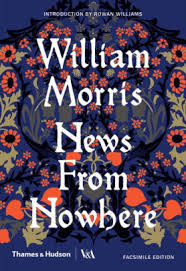
Other novels of interest among those I read this year include Joseph Conrad's Secret Agent, Olga Tokaczuk FlightsStefan's Zweig's The Royal GameChina Achewbe Things Fall Apart, and William Morris's News from Nowhere. I read News for Nowhere in an on-line literature group: we agreed that Morris' socialist utopia, which feels more than a little like  Disney World with better food and without the carnival rides, is marred by Morris' sexism. Once again, it's important to reiterate that women don't, on the whole, have utopian dreams of becoming man's handmaidens. However, there is something deeply compelling in his vision of a garden world, ecologically sustainable and without money, in which people are healthy and content. 


Conrad's Secret Agent is also marred by sexism and by its mean-hearted caricature of revolutionaries. An appalling, destructive patriarchy alienated me, too, from the sympathy I felt I was supposed to feel for Achewbe's tormented protagonist in Things Fall Apart or the sorrow I was expected to feel for the loss of his social order. However, I appreciated the simplicity of its language, and the way the novel highlighted the destructive effects of a patriarchy where brutality towards women and children is normalized and saving face is all important--more important than life itself. And as I have been thinking much about the experience of time this year, I thought I would end with a quote from Flights, from a book ironically about the centrality of travel and movement  at a time we are all grounded:


". . . and perhaps it is possible,” she heard him say, “to look into the past, cast our glances backward, imagine it as a panopticon of sorts, or, dear friends, to treat the past as though it still existed, it’s just that it’s been shifted over into another dimension. Maybe all we need to do is change our way of looking, look askance at it all somehow. Because if the future and the past are infinite, then in reality there can be no ‘once upon,’ no ‘back when.’ Different moments in time hang in space like sheets, like screens lit up by one moment; the world is made up of these frozen moments..."


 Some of the notable short stories I read this year include the following:


I most enjoyed Sylvia's Plath's "Sunday at the Mintons," a pastiche of Virginia Woolf, written under the influence of To the Lighthouse. It won one of the Mademoiselle's two $500 first prize awards in 1952. To my mind, it may well have been influenced by Truman Capote's 1945 Mademoiselle story "Miriam," another interesting read. 


Nadine Gordimer's "The Moment Before the Gun Went Off" is an eviscerating critique of South Africa's apartheid written in a mode reminiscent especially of Woolf, but that I imagine Austen would have appreciated.


Margaret Atwood's "Death by Landscape" stuck with me powerfully, a tale of loss in an ekphrastic mode in which a woman, decades later, is still seeking a lost friend in Canadian landscape paintings. 


I read Alice Walker's iconic 1970s  "Everyday Use" for the first time,  still a powerful indictment of cultural appropriation. 


Sally Rooney's "At the Clinic" launched Marianne and Connell, the main characters in Normal People. It is notable for its coldness. The lack of security  Marianne feels with Connell mirrors the bleak isolation and desolation that lead Anna Karenina to commit suicide: today, apparently, they are normal for a relationship. The story is reminiscent of Mary Gaitskill's "Mirrorball" and Kristen Roupenian's "Cat Woman" and may have something to do with why aggrieved Incels can't get dates. 


As this has taken enough time, I will turn in the near to future blogs to the best non-fiction I read in 2020, the best filmed media I watched, genre fiction, and rereads 


Friday, November 27, 2020

Journal of a Plague Year: A second lockdown

In the past few weeks, Covid numbers have skyrocketed. I am staying home, giving up the yoga classes, the eating out (primarily in outdoor settings) that had gradually seeped back into life during the warm fall, the bits of non-essential shopping, the small physical gatherings. 

World War II has become a touchstone as I hunker down for another few months of isolation. If there was novelty in the first round of social isolation, now comes a grimmer feeling of holding on, especially as the enemy feels closer to the gate: the numbers are skyrocketing not just in some distance place, but where I live. 


Virgina Woolf observed the changes that descended on London during World War II, remembering when: 

houses were open and crowded with friends ... everyone brimming with radical ideas and possibilities.

Now, however, London had become:

merely a congerie of houses lived in by people who work. There is no society, no luxury, no splendor, no gadding and flitting. All is serious and concentrated. It is as if the song had stopped ...

Tavistock Square: One of the Woolf's London homes

 Woolf's description does not describe exactly how my life has changed, as I never was flitting from party to party, but it is close enough to catch the gist. Physical social interactions have all but ceased: what  little "gadding" I'd resumed has once again stopped. 

Yet, I tell myself, there is no threat of bombs dropping, no blackouts, no rationing. We have the comfort of space, rural emptiness, a view of a lake, books, music, film, Zooms, the life of the mind. I have found a literature discussion group, and a Zoom community. 

There has, too, been the heartening election that means the reign of terror brought on by an unhinged leader will soon be over. I read--fittingly enough-- that last time people danced and celebrated in the streets the way they did over Biden's election was at the end of World War II. We did not dance in the streets, but we popped open a bottle of champagne--the first time I can remember doing that for a presidential election. I have been sleeping peacefully through the night since that time. 

Then the virus hit again. We had planned to rent an airBnB so we could meet Will and Olivia halfway between our homes for Thanksgiving. Instead, we zoomed on Thanksgiving with them and Sophie and Ben. Roger and Nick and I made our own meal. 

For about a decade, I had abhorred cooking. But since the pandemic--actually this started slightly ahead of that-- I have been enjoying it again. I liked making the Thanksgiving dinner with Roger, each of us working on our own dishes. 

We hope Will can join us for Christmas, but even so, it will be another quiet celebration. Last Christmas when he visited, we had a fine time doing last minute shopping and going out to dinner--a time that seems a hundred years ago now. It is one of the last moments I can remember that I didn't have a nagging worry about Covid--by late January, when I flew to visit Jane in Maine, I had bought a mask, which I didn't use, but later was very glad to have.

Time

Time in the age of Covid is a subject of an article in Venkatesh Rao in a publication called Noema, put out by the Berggruen Institute, which describes itself as hoping to transform  capitalism and free markets so that they can better respond to climate change and other challenges. While I am highly dubious of any project trying to save so called "free markets,"  the article is nevertheless interesting, if only for providing one of the more creative metaphors for Covid I have ever read:

In lieu of being beamed back up by Scotty, we put ourselves through elaborate decontamination rituals upon our return to base, to rid ourselves of invisible tribbles.
Tribbles from the original Star Trek. Maybe a little too cute for Covid?

 Rao also evokes The Terminator, a movie that couldn't be more relevant as frame for both Trump and a deadly virus, writing: 

The virus could not be bullied, argued with, negotiated with or stopped. (The Terminator quote: "That Terminator is out there! It can't be bargained with. It can't be reasoned with. It doesn't feel pity, or remorse, or fear! And it absolutely will not stop, ever, until you are dead!")
He has to strike before his threat can be felt


Rao's point is that Covid has us suspended in a liminal time or time out of time. We are a water drop, waiting to fall. Or as Rao puts it:

Aion rules ... outside of time .... The weeks and months spent in pandemic time will be weeks and months spent outside of time itself, in Aion’s doorway.

Rao evokes Virginia Woolf to talk about time. He gets her wrong: Mrs. Dalloway was hardly her first novel, and Chronos or the factory time of the clock hardly began with the modernist era, but his evocations at least point to the increasing importance of Woolf as a cultural icon. 


He might have better pointed to the sense of stasis she experienced during World War II, which was a similar period of waiting.  For example, characters in Olivia Manning's Balkan Trilogy, set in the early 1940s, wonder when the war will ever end. Will it go on for a decade? Will they ever have the chance for a normal life?

After the war, life went back to "normal" surprisingly quickly, and for a few years,  looked much like life before the war, although, at least in Europe and Japan, with many ruined buildings. But life did change fundamentally because people irrevocably began to understand the world differently.  It will be interesting to see if the same holds true now. 

The most hopeful note of change I see, and one that started before the pandemic, pushes back against the socially destructive  "me me" individualism that has been rampant since the late 1970s.  I came across this in the New York Times, in which a student writes to Jil, an advice columnist, about  his wish Biden would forgive student loans. For me, the piece's relevance is in its inconsequence. This is no grand philosophical  statement but someone trying to advise the other on the mundane nitty gritty of life in a practical:

My uncle [when the writer wished his loans forgiven] ...got angry and took it very personally: “No one forgave my student loans!” I didn’t know how to respond or if I should have. But it’s awkward now. Any advice?


JIL:

Your uncle’s apparent grievance at the prospect of social progress seems odd. When the Supreme Court legalized gay marriage, for instance, I don’t recall older members of the L.G.B.T.Q. community expressing bitterness that they hadn’t enjoyed the right to marry in their youth. No, we all celebrated the decision as a big step on the road to greater equality.

Same with student debt. The ever-rising cost of higher education has long worked as barrier to students of lesser means and saddled others with crippling debt loads. Black and Latino students have been disproportionately affected. And I would expect people who had experienced this hardship personally to applaud student debt reform.


Jil's support of social unity that applauds the good of others as a good for all and exposes the  attitude of the uncle as mean-spirited, selfish, and petty, is a welcome change. If the virus and the recent appalling spectacle in government and the looming climate change disaster bring us to realize once again what other generations have known--that we are in this together--that would be fairly remarkable. 


Getting back to time, I wonder--will the time before the pandemic seem utterly different? Will this be the great dividing line or simply a blip before we slip back into our old lives?


Sunday, November 22, 2020

Lady Chevy: An Interview with John Woods

John Woods's first book, Lady Chevy, a horror novel, is set in Barnesville, Ohio, the town where he grew up and I live. In the novel, 18-year-old Amy Wirkner, nicknamed Chevy because of her weight, shares a trailer with her parents and infant brother Stonewall. Her parents--and most of her adult relatives--have been psychologically deformed in various ways by relentlessly harsh lives. The latest issue they are contending--and colluding--with is the widespread fracking in their area. In this mythic, inferno-like Barnesville, water bursts into flame as it comes out of faucets, and infant Stonewall suffers seizures and froths at the mouth. The family breaks out in rashes, their eyes burn, they cough. Amy is both laconic and angry over the situation, laying the blame on her parents for signing a contract:
The fracking rig is an industrial spire at the back of our property line, about a quarter mile from our trailer. At night, its twenty-foot flame enchants the orange horizon, a fire’s dance, a hellish light that is no light. We get a check for $900 every month. Mom cashes it quickly, ashamed to have it in her home. The land is ours. It’s still ours. We sold the mineral rights, but that wasn’t all they took.


Amy studies to earn a scholarship to Ohio State so that she can become a vet. At a party, she runs into her close friend Paul. He persuades her to drive the truck he is taking into a fracking station to help sabotage a fracking plant. Plans go awry, and Amy ends up killing a guard--though nobody beyond Paul initially knows she is involved. From there, her nightmare widens. 

Perhaps the best social and political context for Lady Chevy  is China Mieville's 2015 essay “On Social Sadism:" (https://salvage.zone/in-print/on-social-sadism/). Woods makes art out of the sadism Mieville describes as endemic to neo-liberalism: in Woods's telling, Barnesville is one of the locus points on which a neo-capitalist culture of power has unleashed its fury. Mieville's concepts of "a normalised sadism" emerges concretely in this novel. Woods's description of poisonous fracking, is the language of rape:

The earth trembles beneath us, hydraulic blasting, deep groans in the subterranean dark. Chemicals strip away shale, seep into the aquifers, contaminate the soil, and extract natural gas to feed our nation.

and becomes an embodiment of Ann Coulter "gloss" of Genesis 1:28:
God said so: Go forth, be fruitful, multiply, and rape the planet — it’s yours.’ (Mieville)
The larger society's cruelty is inscribed on Amy's body (an added "value" of her 270 pounds is more opportunity for shaming) and those of her family and neighbors, who alternatively are filled with abject self loathing and an equal and opposite will to suppress compassion to present themselves as ruthlessly  "strong." When not abject, they become the mirrors of the dominant sadism.

The characters often lash themselves as harshly as the billionaire class berates them, and many internalize the ethic of the sociopath. To escape and to make something of herself is Amy's driving passion--but as the novel illustrates, for the poor, the cost of such a will for success becomes a never-ending horror story. Amy's deep temptation is to adopt a fascist morality, as articulated to her by Officer Hastings:
“God does not exist. Neither do human rights ...The strong know this, deep down. But we must return to a time long before Christian crosses and Jewish prophets, when the ideas of equality and good and evil were recognized as the idiocies they are”

-- which replicates the ethics of the master, as described by Mieville:
‘The ability psychopaths [in the financial sector] have to turn down their empathy and block out other concerns make them the best operators in high- pressure environments,’ McNab tells the Telegraph. ...
Woods shows the colonized as living in the midwest United States. The bleakness of the novel is the deep shade of the dark enlightenment turned against its own.  Mieville states:
The Enlightenment was always a dark enlightenment. Viciousness and brutality in their most unmediated forms were still – and are – deemed appropriate for the colonies.
Woods uses relentlessly hard hitting sentences and a consistently dark tone to amplify a story animated by a compelling central character and surprising plot twists. Beyond the strong writing and story, it is worthwhile to read the book to explore the consequences of internalizing the sadism of the colonizer. 


All of the above is  prelude to an interview: I had an opportunity for a conversation with John via e-mail about his book and writing life:

1. Me: As we discussed briefly, I have lived for the last 12 years in Barnesville, where the story is set. To a resident like me, the Barnesville you describe, though it keeps some of the street names and mentions some familiar places, is a dark, Gothic version of the town as I know it. Could you talk a little bit about why you used the name Barnesville, and what drove the darker vision of the town? 

John:  I grew up in Barnesville, Ohio. It is my hometown. My childhood was filled with memorable and formative experiences. My family lived just off Main Street next to The First Presbyterian Church, where my dad was pastor. As a child, I had great freedom. I left my front door, rode my bicycle, and explored the town: the Victorian houses, the abandoned factories, the shaded hills, and the dark woods surrounding everything. I got in all kinds of adventures with friends. But in a small, Appalachian community, life is hard. Children are not sheltered from reality, or poverty. You see a lot. You grow up fast. You become haunted. .... at first, I wrote about a no-name town in an undefined state. Then I wrote about a place suspiciously called Belmont. ...  all my writing fell flat. None of it worked. And it didn’t work because it was not grounded in a place I knew and understood intimately. I was withholding. 

... So, I chose the place that influenced and shaped me most. All of my writing is set in the Ohio Valley, with Barnesville at the center. ... [but] ... My depiction of Barnesville is fictitious. The Barnesville I explore in my writing is not the Barnesville that exists. It is a shadowed stage, a nightmare version of a specific place that reflects the world we all inhabit. 

 2. Me: Amy’s a great character, and a reader tends to be on her side, especially at the beginning, yet her character also leans deeply into a “kill or be killed," “survival of the fittest mentality.” Can you talk a little about that, and why you choose that path for her?

John:  I fear such thinking lurks at the core of Amy’s family, our country, and the world. I feel Amy chose her own path. One can’t be surrounded by such darkness without being influenced by it. 

 3. Me: A good writer can—and no doubt should!!-- get inside the head of all sorts of characters that aren’t “them,’ but I am interested in why you chose a female protagonist. 

John:  My fiction involves many different characters and narrators, men and women and children. First person is a special thing. Before writing in first person, a voice must come to me, and then I must inhabit the mental space and language of that distinct voice. That may sound odd, but it’s true. I listen to the voices. And so, the choosing of a female protagonist was not deliberate. Amy’s voice sounded clearer than the others, a kind of severe sorrow and strong resolve tinged with gallows humor and rage, and then I imagined a baby crying on the floor in the shadow of a kitchen where fire came from the faucet instead of water. I imagined a girl wandering that home’s dark halls. That voice, and those images, is what I followed, and then everything developed from that. These voices, of course, are influenced by people I know. And the women in my life have always been strong. And they have always been strong on their own terms, without adhering to any societal conventions of this or that. They are their own authentic selves and make no apologies. They are survivors. 

 4. Me: The novel seems to lack a redemptive moment where good wins over evil in favor of a relentlessly “good guys finish last” ethos. Could you comment on that? 

John: I consider Lady Chevy to be an antithesis to Crime and Punishment. That is the comparison that lingered with me as I wrote Amy’s story. Except here, those redemptive forces are not victorious. I value moral ambiguity, and the existential dread that arises from it. I feel it is dangerous to assume our world is stable, and that a civilization’s moral compass is dependable. 

 5. Me: Amy’s ironically named Uncle Tom, a survivalist Nazi, turns out to be a hollow man—talk rather than action-- or so I took him to be. Why is that? Does that motivate Amy to act? 

John:  Thomas Schmidt is a traumatized character, primarily from his war experiences in Iraq, but also from a “violent childhood.” I understand him as a man possessed by an ideology that does not align with his true self. I would not mistake him as hollow, because I think he truly believes such racist hatred and would act upon it under the right circumstances. But he avoids those circumstances by isolating from the world. I wanted to explore what is beneath such racism, diminishing human beings into nothing more than their biology. And I believe it is the allure of Fascism. Fascism is the amoral application of power, a worldview where “Might makes Right,” and violence ultimately achieves all ends. This pathology then characterizes the state, and its defined people, at the expense of all others. In a toxic environment, these horrific ideas seem attractive and empowering. This is the dynamic between Tom and Amy. Their relationship is an unusual form of influence, because I am not certain either knows transmission is happening. Amy is not a racist, but she is negatively affected by Tom’s worldview. Tom eventually comes to understand this. But it is too late. 

 6. Me: Amy says: 'Barton Shoemaker was never evil to me, just a loving grandpa who told me all life is struggle, an evolutionary war of survival, winners and losers, those who eat and those who get eaten. He told me all this like a bedtime story. I never liked it. I didn’t like how it tore away at everything good. He said it makes a person sad, makes them sick, alone, even when it’s necessary, even after you’ve chosen what side you’re on and carved your name in stone. It all seems wrong and makes you feel wrong. But that doesn’t make any of it incorrect, does it." AND "We’re the apex predator now, nothing to fear but ourselves. I’d eat someone to survive. No doubt in my mind. In a cold, dead world of infinite winter, without sunlight or crops or plants, where nothing grows, a fallen world, I’d chain people up in my basement, harvest them as resource, choose the finest cuts. I’d remove their tongues first, a kind of delicacy. It would stop their talking." Amy, especially in the second quote, seems to have internalized some of the masculinized memes of our culture, at least the far right culture, in large part, I assume, because of her male role models. It seems to me she has developed a gap between her feelings—what feels “wrong” --and her intellect. Are we meant to take away that her intellect has blind spots? Or are we supposed to feel that in her situation she has no choice but to divorce herself from her feelings if she wants to survive? She doesn’t seem to be a sociopath—for example, she has real feelings for her little brother—but she does seem to make a choice to aggressively tamp down her humanity. Can you comment on that? 

John: This is all connected with the previous question concerning Tom’s influence. His intellect has hardened his spirit, his humanity. Amy navigates her experiences similarly, so that she can escape punishment. This also speaks to that Darwinian “survival of the fittest mentality,” which echoes throughout the novel. In my writing, I feel it is important to question some of our most sacred assumptions. One of those assumptions is our association of intelligence with goodness, our belief that logic and reason somehow equate to moral authority. I do not trust human intelligence. The creeping presence of Fascism is the undertow of Lady Chevy. The most dangerous thing about Fascism is that under certain conditions its worldview appears convincing, and its violent methods become, in fact, logically persuasive.  

7. Me: Ultimately, the book left me with the take-away that there is no way out of a dog-eat-dog mentality if one is to survive: Hastings and others seem to survive by that ethos. Is there a way out of that loop for the reader? Is that what you meant as the take-away? 

John:  Amy’s story is not prescriptive. And all the characters in Lady Chevy reflect a similar and shared tragedy. I believe tragedy—personal, familial, intergenerational, historical—often becomes cyclical. It is a closed loop, a kind of Mobius strip, forever repeating and alternating. When I critically consider history and the state of our world right now, I am not sure there is a way out. I hope so. But I also feel that if humanity were capable of creating a world without conflict and violence, we would have done it by now. I would like readers to leave Lady Chevy with a sense of empathy, and a greater awareness of our shared tragedy. 

8. Me: Could you comment on some of the writers and genres that have influenced you? 

John:  I am a literary child of Horror. Without an early attraction to Horror stories, I doubt I would be an avid reader, or writer. Only later did I enjoy the genres of Noir and Literary Fiction. Stephen King, Anne Rice, Shirley Jackson, and Edgar Allan Poe were my earliest influences. Then I discovered the Southern Gothic Tradition: William Faulkner and Flannery O’Connor, then William Gay, Larry Brown, Charles Frazier, Ron Rash, and Tom Franklin, followed by Ohio authors Toni Morrison and Donald Ray Pollock. And then William Golding, Ernest Hemingway, Joseph Conrad, James Carlos Blake, John Steinbeck, and Raymond Carver. All of them influenced me. But Cormac McCarthy and Sylvia Plath are the writers who unlocked the power of language in me and allowed me to discover my own voice, which is the most important thing. 

 9. Me: And finally, what is your next book about? 

John:  It is a collection of short stories, Something Tender. The stories are all set in Barnesville. They are linked narratives, featuring many of the characters in Lady Chevy. In my writing, I want each work to be autonomous, but to also enhance all the others. It is a shared universe. This collection has been acquired by a publisher in France, but it does not yet have a home with an American publisher. I am currently finishing another novel, a murder mystery set in Barnesville during the 1990s. It explores many of the unanswered mysteries within Lady Chevy.

Monday, November 2, 2020

Journal of a Plagued Year: an election day...good leadership...Macbeth

 Four years ago, on the day before the election, I wrote with optimism that soon the Trump candidacy would be over. I imagined we would be celebrating the election of our first female president, a very highly qualified candidate.  I woke up election day morning to The NewYork Times polls telling the public she had a 95 percent chance of winning. By that evening, her poll numbers had slid to five percent.


Malcolm in Macbeth puts Scotland ahead of personal loyalty to him.


Four years later, older and more sobered, I face tomorrow's election with dread--as I am sure most do on both sides of the aisle. Yes, the polls tell those of us center and left that Biden is ahead, but we've been down that road before. We're told this time the polls are "different." My sense, living amid a sea of Trump flag and banners, is that hardcore Trump supporters don't talk to pollsters, so perhaps the situation is not different. 

I fear, too, that a close election will be quickly contested and end up in a Supreme Court that now contains three justices handpicked by a man who puts personal loyalty to him ahead of all else. I wonder whose side they will be on? One is an entitled imbecile who joined the right Clinton-hating boys' club at the right time, while another is a cold-hearted cult member who recently ruled that a supervisor calling a Black the N-word is not evidence of a hostile work environment. The mind reels.

Still, one hopes. Hope is this and that: I won't rehearse the cliches. To look at the bright side, the current situation has galvanized many people out of political apathy. . 

But what I really wish to talk about is good governance. From the time of Sophocles, who lived in the 400 BC era, thoughtful and ethically grounded people have understood that responsible leaders have a responsibility to put the good of the people ahead of their own self-interest. Oedipus, for example, though an arrogant man, voluntarily exiled himself from Thebes so that his people would no longer suffer a plague. He gave up his power for the benefit of the governed.

In Macbeth, written some 2,000 years later, the same ethic applies. Macbeth, who cares only about his own power, has increasingly thrown his country into chaos, to the point of civil war. He is indifferent to the fact that he has proven himself divisive and unfit to rule. He simply wants to win, no matter how. He makes personal loyalty to him all important: he assassinates those he perceives as a threat.

In contrast, Malcolm, the rightful heir to the kingdom, places loyalty to country ahead of loyalty to self. He tests Macduff in Act IV, scene iii,  pretending to be an evil, greedy, rapacious, and self-interested would-be king. He sums up this false self to Macduff, saying he is:

But I have none: the king-becoming graces,

As justice, verity, temperance, stableness,

Bounty, perseverance, mercy, lowliness,

Devotion, patience, courage, fortitude,


I have no relish of them, but abound

In the division of each several crime,

Acting it many ways. Nay, had I power, I should

Pour the sweet milk of concord into hell,

Uproar the universal peace, confound


All unity on earth.


In other words, Malcolm paints a picture of a poor leader as a man almost exactly like Donald Trump. Malcolm claims not to care about justice, truth, moderation, stability, mercy, humility, devotion, or patience. He says he will do what he can to create disunity and chaos in his country and on earth.


Macduff, as Malcolm hopes he would, recoils in horror. He refuses to have anything to do with such a person, stating that Malcolm is not:


Fit to govern!

No, not to live. 

One of Blake's illustrations of Dante's hell

 Malcolm is well pleased with this answer. As a good king, he wants followers who put loyalty to Scotland ahead of loyalty to him. A person like Macduff  who tells him the truth  is a person he wants behind him.


We might contrast this to what those close to Trump have repeatedly said about him, as reported by Ron Suskind  in The New York Times (https://www.nytimes.com/2020/10/30/opinion/what-happens-on-nov-4.html):


  It all came back to loyalty. He needed to get rid of any advisers or senior officials who vowed loyalty to the Constitution over personal loyalty to him. Which is pretty much what he proceeded to do.


That we might vote in such a man shows we are a country, like Dante at the beginning of the Inferno, that has lost its way. Part of this arises from being propagandized in dramas such as The Sopranos, Breaking Bad, Game of Thrones, and Westworld. Here we see ruthlessness and sociopathology valorized as central to success, not as the unfortunate and evil shadow that sometimes dogs and destroys assertive leaders. We need to go back to a world in which these traits are understood as evil. 


Like Dante, we are now on the brink of the last circles of hell, having spent four years in some of the outer circles. I hope we have learned enough to avoid the rest of the tour, but the future seems very much in the balance.


Tuesday, October 20, 2020

Journal of a plagued year: Jane Austen, legality, and Amy Conan Barrett

 Jane Austen's relatives, notably including her brother Henry, carefully preserved an account of what their great grandmother, Elizabeth Weller Austen, suffered under the law.

Jane Austen knew the story of her great-grandmother, Elizabeth Austen Weller

After Weller's husband died, leaving her with seven dependent children ten years old and under, she applied to her wealthy father-in-law for payment of her late husband's debts. She was, on her own, able to raise more than 500 of the 700-plus pounds her husband owed, a small fortune in 1704, and received a verbal promise from her father-in-law that he would pay the rest.

Unfortunately, the father-in-law died suddenly. His will largely ignored Weller Austen and her six youngest children, to her distress. Her husband's brother-in-laws, the executors of the will, refused to honor the father's verbal agreement to pay her debts. It was not technically stated in the will that this was to be done, therefore, technically, the estate wasn't liable. 

This legal, but cruel act, forced Weller to sell her personal possessions and also to become a housekeeper for a man who ran a boarding school to secure a future for her children. The trauma of her fall in social status, her humiliation, and the hard-heartedness of the family in charge of her fate, clearly shook Elizabeth Weller Austen to the core. She was a strong woman who fought back and earned a decent future for her offspring, but the scar remained as an intergenerational reminder of injustice.

Most people don't know Weller Austen's story, but Austen fans are familiar with the early scene in Sense and Sensibility in which, through step by step parsing and rationalization, John and Fanny Dashwood twist John's dying father's wish that his second wife and her daughters be well cared for out of his estate to an occasional cheap gift. Because the father has made no legal provision in his will, the couple, having the power, can and do legally strip the women of what their father intended.

Austen treats this series of events, inscribed with the Austen family's  intergenerational trauma, with caustic, stinging humor.

Austen encoded the story of Elizabeth Austen Weller in her first published novel

Likewise, in 1848, feminists at Seneca Falls published Declaration of Sentiments opposing the husband's legal right of "chastisement" (beating) of his wife. For more than twenty years, courts rejected what they called sentimental legal challenges to legal wife beating, pushing back that by saying, yes, certain cases were heart-rending, but that should not get in the way of the legal importance of not interfering with the male right of chastisement as head of household, be this of wife, servants, or children. 

Amy Conan Barrett

This brings us to Supreme Court nominee Amy Conan Barrett, who opined in the case Martin v Milwaukee County that Milwaukee County was not liable for having to pay $6.7 million dollars awarded in damages to a female prisoner repeatedly raped by a prison guard. Instead, the three-judge panel ruled,  the perpetrator alone, a Mr. Thicklen, was responsible:

But even when viewing the evidence in the light most favorable to Martin and the verdict, we hold no reasonable jury could find the sexual assaults were in the scope of his employment …

Uncontested evidence at trial demonstrated County thoroughly trained Thicklen not to have sexual contact with inmates. County expressly forbade him from having sexual contact with an inmate under any circumstances, regardless of apparent consent. County’s training warned him that such sexual contact violates state law and the Sheriff’s Office’s mission. (source: https://www.snopes.com/fact-check/barrett-jail-guard-ruling/)

In other words, even though Thicklen used the power of his official position and the weapons given to him by the county to threaten Martin with retaliation if she did not comply, if a county tells a guard "not to" assault prisoners and he does, the county is off the hook for damages.

The court also acknowledged that there was little chance that Thicklen would be able to pay the damages, stating "we have sympathy for Martin, who loses perhaps her best chance to collect the judgment."

How much sympathy do you think Barrett actually has for Martin? As in the case of the Elizabeth Weller Austen and the Dashwood sisters, a narrow concept of legality won the day against human decency. Such interpretations encourage the powerful to encroach on the weak by using legality as a stick with which to beat common notions of moral justice.

Barrett's narrow, hard-hearted view of legality appears to strive to ignore the human consequences of legalism. What do you think Jane Austen, often pictured as a conservative, upstanding Christian moralist, would have thought of Amy Conan Barrett's decision in  Miller --or , more to the point--with her nomination to the Supreme Court? 


Tuesday, September 8, 2020

Journal of a Plague Year: Misogyny, NXIVM, Trump

 have been disturbed lately over facing an onrush of misogyny and sexism. I have, for example, bumped up repeatedly against the motif of women in adoring service to the "great man," as can be seen in such "critically acclaimed works" as the musical Hamilton, and the 2017 film Phantom Thread, which was nominated for six Academy Awards, including Best Picture.* The unspoken assumption in these works is that a woman has no higher calling than to adore a dominant male. 

Male sexist fantasy reared its head as well in Morris’s Utopian fiction, News from Nowhere, which I recently read. Here, Morris depicts an ideal society filled with attractive women who embrace as "natural" a desire to wait on men--this is a mild sexism, but sexism all the same. The handmaid theme emerged in an uglier way in a  time travel short story by Robert Heinlein called  "By His Bootstraps." In this story, the male protagonist, Bob Wilson, is serviced in a future world by a bevy of willing, young, and beautiful females who seem to have no other desire but to adore and wait on him (including, it is suggested, sexually servicing him). Needless to say, he needs to do nothing to deserve this treatment.  Being a man is ample qualification for worship, despite the story characterizing him as both stupid and callous. 


In the past and up to today, I have been concerned about what I call ritual humiliation of women in filmed media. This first came home to me when at the end of 1997 I watched a lovely 1940 Ernst Lubitsch film called Little Shop Around the Corner. It was remade shortly after as You've Got Mail. Seeing the two films back to back I couldn't help but notice that the female lead in the later film was subjected to humiliation by the male before she could be worthy of his "love." This aspect was completely missing from the earlier Lubitsch version, in which the two opposite sex leads are treated as equals. It uneasily came to me that we were going backwards on sexual equality. 

After, this I began to notice that most current films had a scene in which a woman is ritually humiliated. In one romantic comedy, a woman who owns a bakery has to chase after her "man" and beg for help with car repairs when she is stranded on the side of the road. At the end of Game of Thrones, the uppity women leaders who have not yet been properly disciplined through repeated rape, cruelty, and abuse are killed. The men triumph. Among Trump supporters I have noticed a meme of "cute" cartoons in which a "FemiNazi" (often depicted as a female head on a cat's body) speaks out and is bested and silenced by a much larger Trump, who gets the final word. 

I have also been reading about Incels (involuntary celibates), an Alt-Right group of aggrieved men who feel that they deserve to date not any women, but what they consider the “hottest” women of the world: white, blond, sorority members. This is pointed out in Elizabeth Sanifer's excellent evisceration of idiot male Alt-Right "thinkers" in her book NeoReaction: A Basilisk. I have also read Kate Manne's recent work Entitled, which discusses male Incels among other examples of male privilege. 


Lately, too, Roger and I have been watching HBO’s The Vow, about the cult  NXIVM. The leader, Keith Raniere, is a sociopath very much in the Trump mold and mindset. Raniere was recently found guilty of a host of crimes, including sex trafficking. He  literally branded female sex slaves that he felt he “owned.”  I find—or so far have found—the series fascinating, as I can understand how one would be attracted to a group that professed to want to build a more ethical world, though it becomes clear that Ranier’s idea of “ethics” was based on the savagery of Ayn Rand. Like Trump, Ranier is an arrested adolescent attempting to play out sick and puerile fantasies. Unfortunately, like Trump, he got far too far. 

Ranier and his brand. It is a sideways "KR:"  his initials.


It is profoundly depressed to read the passage below about Ranier, his sex cult, and his deep misogyny towards women. What disturbed me is that Ranier pinpointed what are, I believe, common attitudes among men: feelings that women are “entitled” (which seems to mean resentment that they want to share the voice, space, and resources once the sole domain of men), that women use their sex to get advantages, and that women are undisciplined (which seems to mean “unmanly” in the context of the sadistically brutal way some men are formed). He also seemed filled with rage that women might dress “provocatively:” this is another complaint I have often heard men level at women, as if the clothes we wear were not designed (especially for young women) by the male fashion industry to be provocative—even for little girls, as I found trying to dress a young daughter in the 1990s.** 

As is typical in what we see in filmed media, Raniere wanted to humiliate women into “obedience.” 

Encountering so much misogyny leads me to wonder why some men hate women so much and have such distorted views of women. This has real urgency, since a man who displays all the worst tendencies of misogynist men and flaunts this as a positive feature, playing into sick male fantasies, has highest power in the US and may be reelected or even become our dictator at a time when climate change threatens human extinction. Men have to get over these attitudes if we are going to survive as a species.  Woman are not here to adore and service them. That, in fact, is a fatal and disgusting disease that too many women have been conditioned into perpetrating. (Mutual support between equals is another story.) Women, also, are not “entitled" because they want equal voice and power to men.  We need this equality to happen if we are going to survive.  

The following on Ranier and NXIVM is from a May 13, 2019 Rolling Stone story:

In 2013, Raniere decided that he wanted to open up the SOP [male only] curriculum to female members of NXIVM, dubbing the new course SOP Complete. Although Vicente [who turned on the cult] testified that he initially had “concerns” about opening up the group to women, he later relented when female members of NXIVM’s inner circle spoke with him and said they wanted to take the class.
Those concerns turned out to have been justified, however, when Raniere introduced SOP Complete to group members by telling them the primary tenets of the group: i.e., that women “lack discipline,”  were “entitled,” and were “misusing their sexuality to gain an advantage in the world,” Vicente testified. The goal of the curriculum, which was authored by Raniere, was to give women “the experience of being a little boy in a man’s world,” or to essentially tease and bully them until they were forced to grow up and assume responsibility for their actions. “‘We’re gonna help them find themselves and push them the same way you were pushed,'” Vicente recalled Raniere saying.
SOP Complete, Vicente testified, was “run more like a boot camp” than an academic curriculum. In addition to using hazing and other military-inspired tactics, such as forcing group members to do “penance” for misdeeds in the form of planks or wall-sits, SOP Complete instructors also used props, such as fairy wings, to humiliate female members into submission.
At one point, Clare Bronfman, the billionaire Seagram’s heiress who had at this point assumed a central role in NXIVM, was given a “jock strap” for being “too bossy,” according to Vicente. Raniere also suggested that male group members take photographs of the women if they were dressing provocatively and then make a video slideshow to humiliate them.
Although Vicente said that he had reservations about SOP Complete, testifying that even his wife had approached him with her concerns about the group, he nevertheless kept participating in the group. “I believed with some reservation that the women wanted to feel stronger and this would help in some ways,” he said, before eventually coming to the realization that the aim of the group was to “make women submit to men and be obedient, no matter what.”

Raniere is a sick and sadistic person who starved his sex slaves so they would conform to his beauty image and had them branded with his initials naked and without anesthetics. It is worth noting that NXIVM was a highly hierarchical organization: hierarchy is part of the warped social order that gives some groups and people undue power over others. 
 
I don't know why deep atavistic male fantasies seem to center on wanting women as adoring and obedient sex slaves, but the stakes couldn't be higher for abandoning that idea and creating a post-misogynist world. (As has been much noted, for example, the countries doing best against Covid are run by women.) I have much more to say, but will stop here; fortunately we live in a world where, despite all attempts to the contrary, women are getting more of a voice and are more and more realizing there is no "empowerment" in trying to replicate stereotypical masculinity. 


A a final note, a long line of women writers who continue to be influential solace me greatly, from Mary Wollstonecraft to Jane Austen to Mary Shelley to Virginia Woolf and on up. We need to listen to what they are trying to tell us. 

*Phantom Thread was nominated for a slew of Oscars, partially in an attempt to give Daniel Day Lewis his “due.” I have to say that I was appalled that "honoring"  Lewis was considered a reasonable excuse for amplifying a sick film in which adoring handmaids tolerate a “great man’s” cruel and verbally abusive behavior on the unstated assumption that women can have no higher goal than to service and worship the 'heroic" male.  And did this entitled white male (Lewis) really need an Oscar nomination? Could he not have simply gotten lifetime service award? Or just lived on his laurels? 

**I had to sidestep little short-shorts with ruffles on the rear end and tee-shirts in pink decorated with hearts and mottos like "I am your little sweetheart." 
_._,_._,_