
 |
| Margaret Jolliff 's1935 painting of Mecklenburgh Square, an image of the locale before it was bombed in the war. Even today, as an adult, I can imagine myself into this scene. |

The women Wade features--H.D., Dorothy Sayers, Jane Harrison, Eileen Power, and Virginia Woolf--all lived for some portion of the interwar period in Mecklenburgh Square on the edge of Bloomsbury. Wade calls the square "a hidden architectural gem in the heart of London" and describes it as the home of "students, struggling artists, and revolutionaries." I loved reading this book as it gave me a fuller sense of the like-minded community surrounding Woolf. Wade shows that Woolf's thoughts did not spring out of a vacuum but out of a milieu. Often, she can seem to shine as a lone genius, the one blazing star speaking for women in her period, rather than one of a multitude of far-seeing people working to solve what they perceived rightly as the interrelated problems of patriarchy, war, hierarchy, and inhumanity. Much of what Woolf says is influenced and amplified by the work of these other women--and Woolf's literature echoed and reinforced their scholarship.
In this post, I would like to concentrate on Jane Harrison, a classicist born in 1850, and a dynamic, intellectually engaged woman until her death in 1928. She was a friend of both Woolfs. They published her short autobiography Reminiscences of a Student's Life as a Hogarth Press title in 1925. Present day classical scholar Mary Beard has published a biography of Harrison called The Invention of Jane Harrison.
 |
| Portrait of Harrison by Augustus John. She liked John, apparently unaware that his wife sacrificed her art career for his. |
Harrison, who lost her mother shortly after birth, was exactly the type of person Woolf had in mind when she wrote A Room of One's Own. As Wade points out, Harrison was a role model for her, though Woolf was not afforded the same coherent educational opportunities.
 |
| Mary Beard's biography. The photo is of a younger Harrison |
Harrison had the good fortune first, to be sent to Cheltenham Ladies School, then the premier boarding school for wealthy women in England of the "ladies" class (tradesmen's daughters, no matter how wealthy, could not attend). Her greatest good fortune, however, was to inherit 300 pounds a year from her mother when she turned 21, a sizable income at the time. This gave her financial independence and liberated her from her father who did not believe in higher education for women. In 1874 she used her money to enroll in Newnham College at Cambridge, a woman's school begun just three years before. Thus, with the money inherited from another woman, Harrison was able to forge her own destiny. Harrison used her economic freedom to become a classical scholar, a traditionally male field.
 |
| The young Woolf |
Woolf first met Harrison in 1904 while convalescing at her aunt, Caroline Stephen's, home in Cambridge. Caroline Stephen, who like Harrison never married, was Woolf's savior, leaving her enough income to achieve financial independence when combined with other inheritances. Even after the war, when massive inflation had badly eroded interest income, Woolf, with Leonard, was able to pursue her vocation through careful budgeting, writing book reviews, and eking out what was at first a marginal living from Hogarth Press: Harrison referred to them as "poor as rats" but did not disparage that. (Caroline used her inherited money to research women's communities, such as convents, to write, and to build a block of working class housing in downtown London.)
Harrison was a person of rare courage She left Newnham late in life because she was tired of the kowtowing and timidity of the woman's college. She stated:
much of our ingenuity & energy goes into cringing
In later life, having left Cambridge, she became a Russian scholar.
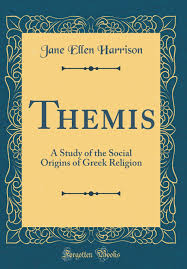
According to Wade, Hamilton, before leaving Newnham, shook "the foundations of classical scholarship” (154) by studying new archeological discoveries (some from artifacts which she saw come out of the ground) and asserting that “powerful goddesses” once “reigned alone over cult shrines.” These goddesses were gradually “effaced” and replaced by Zeus. At one time, women’s activities were at “the heart of [Greek] community life” and “‘matriarchal, husbandless goddesses’ were not mocked or feared but reverently worshipped.” (155) Wade states that Harrison's work gave Woolf a “new, subversive model of history which informed all her subsequent novels and essays." (158)
In her Themis, radical at the time in its assault on patriarchy, Harrison argues that Greek religion originated in a matrilineal (though not matriarchal) world. The cosmos was presided over by the goddess-like figure Themis who stood “above the gods, supreme, eternally dominant … She is … the collective conscience projected” (xvii). Themis was also “the very spirit of assembly incarnate” (485). She represents an early, pre-patriarchal worldview in which “man [sic] and nature form[ed] one, indivisible whole” (xviii).
In this universe, plants and animals are equal to humans, and “if one member of that body suffer, or prosper, all the other members” do too. ( 533-34) Harrison asserts that ancient Greek religion enacted rituals to remind humans that they are merely a “specialized fragment” of a far larger whole of nature. (xix). These rituals, in which people, for example, would dress as animals, enacted getting into the skin of the non-human world in the same way a child might enter imaginatively into a painting.
Harrison considered the pantheon of patriarchal Zeus' family which replaced the earlier religion a sad diminution of the earlier Greek faith: in Zeus' world: “The family comes before us as the last forlorn hope of collectivism” (491).
Harrison's words echo across time: in the twenty-first century it sometimes feels the only people we are allowed to fully care about beyond ourselves are immediate family members. This leads to a sad sense that community has diminished. Surely, too, if we are to save the planet we must come to understand once again that we are merely a “specialized fragment” of a far larger community.
Harrison's thought leads us to understand the importance of feeling a oneness or unity with the plant and animal world. It leads back as well to Woolf's Between the Acts.

Woolf read Harrison's books, visited her in Mecklenburgh, and attended her funeral. In Between the Acts, her last work and one written under war's shadow, Woolf tried to transport the communality of ancient Greece that Harrison describes to England. With a Themis-like woman orchestrating the ritual, the entire community of an English village comes together for a pageant, including plants and animals. Miss La Trobe, the author, incorporates not only the village "idiot" but nature into her pageant to create an inclusive whole, the mooing of the cows and the start of rain incorporated into the rhythm of her performance. This accords, Wade notes, with what Harrison argued for in a book she gave Woolf: her Ancient Art and Ritual, which asserts that the beginnings of Greek drama lie in “ancient community rituals” (Wade 286) and ends by pushing for a return to “a communal style of art and living,” (Wade 288) as a way to avoid war.
Woolf illustrates in Between the Acts an entire community, as in ancient ritual, for a transitory moment becoming one:
'A-maying, a-maying," they bawled. "In and out and round about, a-maying, a-maying. . .’” It didn't matter what the words were; or who sang what. Round and round they whirled, intoxicated by the music.
 |
| A May Day dance at a great house. Traditional rituals, Harrison and Woolf thought, could build inclusive community and promote peace. |
History has to be reframed, Woolf believed, to create a world without wars, a history of life, not death. But not everyone in Between the Acts is happy about the omission of warfare from the pageant's survey of Britain's past:
Colonel Mayhew asks “Why leave out the British army?,” a sentiment echoed by his wife: “Also, why leave out the Army, as my husband was saying, if it's history?”And that question will lead us to another friend and contemporary of Woolf's dedicated to peace through a reformulation of what matters historically: historian Eileen Power, who will be the subject of the next blog.


