Showing posts with label Woolf. Show all posts

Monday, April 20, 2020

Rockwell Kent's World Famous Paintings: Art's Remarkable Afterlife

 "Begone purity!" cries Woolf in Orlando.  When Woolf's Purity speaks she says:
With my robes I cover the speckled hen’s eggs and the brindled sea shell; I cover vice and poverty. On all things frail or dark or doubtful, my veil descends. Wherefore, speak not, reveal not. Spare, O spare!
Or as the captain reminds Crusoe in Tournier's Friday, before the ships sinks:

“Crusoe,” he said sternly, take heed of what I say. Beware of purity. It is the acid of the soul.”

As a child, I lived in a state of innocence. This is never total, and I was well enough aware of seeing poverty in Baltimore and witnessing unhappiness in adult lives that seeped into my own. Nevertheless, my experience of looking at paintings in an art book was innocent and unmediated.

As a child who liked to swing on swings, for example, I was fascinated with the fantasy quality and wretched excess--the extraordinary sensuality, as I would now see it--of Fragonard's "The Swing," especially the voluminous gown and the shoe flinging off. As a child, I thought losing the shoe was an unfortunate accident that would mean the woman would have to get off the swing (!) and retrieve it, not the flirtatious device it probably is with two lovers hiding in the bushes. I thought, too, because of the lost shoe and what looked to me like a ball gown (though it is not) that the painting had something to do with Cinderella, a story I had listened to on a record many times with rococo Swan Lake as the background music.


Rococo excess 

In my years of experience, I know something of the cost to others of maintaining this idyllic world.  We remember innocence, but overlay it with experience, bypassing  purity that clings to a false reality.

Kent writes of "The Swing: with the words "From Swing to Guillotine," causing  me wonder to if these very words inspired Yinka Shonibare's headless version below. That is a fanciful idea, but hardly impossible.


The excess of beheading in a story retold


Shonibare, the Tate's page tells us--https://www.tate.org.uk/art/artworks/shonibare-the-swing-after-fragonard-t07952--is British Nigerian and dressed his darker skinned woman in bright African print fabric. This 2001 version leaves out the men hiding in the bushes, and allows us to walk around it and view it from all angles. One can take on the voyeuristic pose of the men below and look up the woman's skirt: she is dressed in knickers beneath her dress. Is the installation showing the bad end of frivolity in the decapitated swinger? Or is it showing that her life was mindless from the start. Why dress her in African prints: to universalize her or to show the Deleuzian flows of colonialism that supported French excess--though in the eighteenth century these would not have been the main support?


"Hope" by George Watts


The painting above used to appall me and confuse me as a child. Why was the woman blindfolded? Why did the blindfold seem to be attached to a strange, tortuous instrument? Why was such an odd image in this book? I sometimes would stare at it and sometimes flip quickly past it. I remembered this painting being called "Justice," thinking, in later life, that it represented justice as blind, but I now see it is called "Hope." Rockwell Kent shows his dislike of this nineteenth century painting by quoting Hazlitt: 

"Indifferent pictures, like dull people, must absolutely be moral." 

Kent calls it "pure allegory" and goes on to say that this picture has "probably appeared more often than any other on illustrated calendars." How times have changed: I have never seen this image on an illustrated calendar. I suppose it makes sense that hope is blind? Is the woman playing a lyre?  Is she attached to it, as I thought as child? (Probably not.) 

I did some research on it. This "research" meant a trip to Wikipedia, where I found useful information. I am currently be reading Tocarczuk's Flights in a online group and enjoy her words on Wikipedia: "Mankind's [sic] most honest cognitive project ... it will hold everything! Let's get to work." The Wikipedia entry says:
Radically different from previous treatments of the subject, it shows a lone blindfolded female figure sitting on a globe, playing a lyre that has only a single string remaining. The background is almost blank, its only visible feature a single star. Watts intentionally used symbolism not traditionally associated with hope to make the painting's meaning ambiguous. While his use of colour in Hope was greatly admired, at the time of its exhibition many critics disliked the painting. .... 
Despite the decline in Watts's popularity, Hope remained influential. Martin Luther King Jr. based a 1959 sermon, now known as Shattered Dreams, on the theme of the painting, as did Jeremiah Wright in Chicago in 1990. Among the congregation for the latter was the young Barack Obama, who was deeply moved. Obama took "The Audacity of Hope" as the theme of his 2004 Democratic National Convention keynote address, and as the title of his 2006 book; he based his successful 2008 presidential campaign around the theme of "Hope".

 I am fascinated by the idea of life as circular journey, and so it is satisfying to circle back and revisit images from early childhood, seeing them through the double lens of childhood response and adult knowledge. My own life trajectory from innocence to experience (or awareness) is reflected in the unexpected ways very conservative pieces of art have been redeployed to make a commentary on oppressed peoples.  My pleasure in these paintings spikes as I understand they have grown with me: they are not dead art but have been enlivened with new meaning based on new political realities.

My aware self can look at the original of  "The Swing" with the unadulterated pleasure of viewing a fantasy scene, but I experience pleasure, too, in knowing that justice fell on the class depicted--and that a new version of this work exists that shows that. Likewise, I feel affirmed that initial critics were sometimes repelled by "Hope" just as I was. I feel buoyed too, that this painting by a privileged British artist fascinated by Greek sculpture, with all that implies, found a home as an inspiration for the American Civil Rights movement and inspired our first black president. I imagine Kent would be happy too--happier than he could have anticipated.


A labyrinth. Circling to the same center, knowing it will always be different when you arrive. 

Returning to Woolf, she too was drawn to time's circularity, such as in the return of more experienced and aware Lily Briscoe to a site of love and (adult) origin as journeys back to Isle of Skye to finish her painting in To The Lighthouse. Circularity can bring a sense of completion as we bring a new consciousness to bear on what has gone before.

Thursday, April 16, 2020

Journal of a Plague Year: Rockwell Kent's World Famous Paintings: From Innocence to Experience

There's something thrilling about finding a lost book from childhood. I had in years past tried and failed to find an art book that my younger brother and I spent no doubt too much time perusing: http://janeaustenandotherwriters.blogspot.com/2020/04/journal-of-plague-year-open-windows.html. A few days ago I located the book on-line without then knowing the author or title: it is Rockland Kent's World Famous Paintings. My used copy has now arrived.


As is often the case, childhood memory exaggerates size. This book is a hefty tome of biblical proportions but not quite as heavy and thick as I had remembered. The volume we had on the coffee table decades ago lacked the wear of this copy. 
I did not learn to read until age six, though everyone else in the world seems to have been poring through Narnia at age four and reading Milton at five, so the heyday of this art book dates to my pre-literate years. At best, I was gazing at it when I had the minimal skills to read a bit of it--ironically, as soon as I could read well enough for chapter books, my need to fill the time by looking at paintings disappeared.

So I was delighted to re-encounter this book with all the advantages of literacy and context. I read Kent's introduction and was so pleased with its kindness and good humor that I looked him up. He was a humane and decent man, an artist who found himself in trouble in the McCarthy years. He had his passport revoked in 1950 for being part of World Peace Council, which launched the Stockholm Appeal calling for nuclear disarmament. As a pacifist myself, this added to a strong sense of identity. In another  serendipity, I was thrilled to find out his former artist's cottage in Maine is on Monhegan Island, just a few miles off the shore from the home of my friend Jane.


Rockwell Kent's Monhegan Bay in Winter. This hangs in the Metropolitan Museum of Art.


 From Kent's introduction, in which he invites the viewer to have an unmediated encounter with the art on his pages (in other words, to trust one's own instincts), I realized that a young child is a perfect audience for him. Today, as I could not then (not being able to read) I appreciate his light-hearted and humorous disparagement of the stuffy formality of art galleries and his enthusiasm for the freedom that comes from being able to leaf through an art book in the casual comfort of one's own home.  I was also surprised to find out that he did not choose the paintings for the book. He says he would not have picked all of them, but also states he tried not to let us know which ones he didn't like in the comments on each one he wrote with a partner. Only one work is by a woman: a self-portrait with her daughter by Madame Vigee Le Brun. The non-western tradition does not enter in at all--except as far as Kent can insert a few hints. Abstract art is also not on these pages, though Kent does mention Picasso in his introduction.

I had forgotten that a Van Dyke portrait of King Charles I graces the cover. The book is indexed--all by plates as the book has no pagination.  An oddity is the order of the paintings. While they start in the Renaissance and are in roughly chronological sequence, Cezanne, Renoir, and Van Gogh are stuck in the middle, ahead of Reynolds, Gainsborough, and Turner: a curiosity. Did the typesetter get confused? I don't know if that was remedied in a later edition.

I remembered almost all of the 100 plates in the way one recalls intensely the details of childhood while the important facts of the present quickly fade, but some pictures remained more firmly lodged than others in my memory.

Two that jump out at me are as follows:

The De Hooch below is called "Interior of A Dutch House." I offer a detail that shows what Kent notes--that you see the tile floor through the serving woman's skirt. Kent attributes this to the servant painted in as "a hurried afterthought." I first thought it might be evidence of a forgery, but that doesn't seem to be the case.

The fuller picture is below this, showing the height of the room and the clarity of the paint and the light.


This painting fascinated me as a child because I had never quite seen a room like this--and it seemed oddly empty to me. I was also fascinated that the floor was very much like the asbestos tile floor in our basement (though there the darker tiles were a deep green).  Kent praises the simplicity of Dutch rooms, though this looks to me like a well-heeled interior. (As a child, I thought the people must be poor because of the lack of furniture.) One can vaguely see what look like bones--food refuse--thrown on the floor.


I had utterly forgotten the painting below, called "Between Two Fires" by American Francis Davis Millet, until I leafed through my newly-purchased tome. What would always startle me about this painting as a child, which I now know is a late nineteenth century evocation of a scene from the Puritan American colonies set in the same period as the de Hooch, was how oddly bright and white it was, unlike any other painting in the volume.

The curve at the top of this photo reflects the way the page curves down toward the binding while the shadow in the lower left is one I cast--it is not in the original. I placed an internet version below.

This internet version loses some of the startling white brightness of the painting. I learned reading Kent's introduction that Millet went down with the Titanic in 1912.

I will stop here, at a point where I am still looking at a painting through a child's eyes: the surface features, quality of light, squareness of line, empty space in a room, each encounter with these paintings a place of emotional intensity and new discovery, as if I both had and never had seen the picture before I looked again.

However,  a new encounter with the past changes everything, and a sense of purity gets lost as we dig beneath the surface. As Woolf says in Orlando--"Begone purity!" Or as the captain reminds Crusoe in Tournier's Friday, before the ships sinks:

“Crusoe,” he said sternly, take heed of what I say. Beware of purity. It is the acid of the soul.”

Bonhoeffer, too, deeply distrusted purity.

With that as a prelude, the child's purity and innocence of perception will be replaced by something perhaps deeper and richer in the next blog, as I briefly explore how two mainstream iconic examples of elite--or effete--Western art in World Famous Paintings have been redeployed for purposes undreamed of by their artists. 


Monday, April 6, 2020

Journal of a Plague Year: Jane Harrison, Virginia Woolf, and community

My last blog on the intense feeling of oneness a child can experience with a painting--or any aspect of the world--is a good segue into Jane Harrison, a classical scholar who was a friend and influence on Virginia Woolf. She is one of five women writers featured in Francesca Wade's superb new book Square Hauntings.

 Margaret Jolliff 's1935 painting of Mecklenburgh Square, an image of the locale before it was bombed in the war. Even today, as an adult, I can imagine myself into this scene.  


The women Wade features--H.D., Dorothy Sayers, Jane Harrison, Eileen Power, and Virginia Woolf--all lived for some portion of the interwar period in Mecklenburgh Square on the edge of Bloomsbury. Wade calls the square "a hidden architectural gem in the heart of London" and describes it as the home of "students, struggling artists, and revolutionaries." I loved reading this book as it gave me a fuller sense of the like-minded community surrounding Woolf. Wade shows that Woolf's thoughts did not spring out of a vacuum but out of a milieu. Often, she can seem to shine as a lone genius, the one blazing star speaking for women in her period, rather than one of a multitude of far-seeing people working to solve what they perceived rightly as the interrelated problems of patriarchy, war, hierarchy, and inhumanity. Much of what Woolf says is influenced and amplified by the work of these other women--and Woolf's literature echoed and reinforced their scholarship.

In this post, I would like to concentrate on Jane Harrison, a classicist born in 1850, and a dynamic, intellectually engaged woman until her death in 1928. She was a friend of both Woolfs. They published her short autobiography Reminiscences of a Student's Life as a Hogarth Press title in 1925. Present day classical scholar Mary Beard  has published a biography of Harrison called The Invention of Jane Harrison.


Portrait of Harrison by Augustus John. She liked John, apparently unaware that his wife sacrificed her art career for his. 

Harrison, who lost her mother shortly after birth, was exactly the type of person Woolf had in mind when she wrote A Room of One's Own. As Wade points out, Harrison was a role model for her, though Woolf was not afforded the same coherent educational opportunities.

Mary Beard's biography. The photo is of a younger Harrison


Harrison had the  good fortune first, to be sent to Cheltenham Ladies School, then the premier boarding school for wealthy women in England of the "ladies" class (tradesmen's daughters, no matter how wealthy, could not attend). Her greatest good fortune, however, was to inherit 300 pounds a year from her mother when she turned 21, a sizable income at the time. This gave her  financial independence and liberated her from her father who did not believe in higher education for women. In 1874 she used her money to enroll in Newnham College at Cambridge, a woman's school begun just three years before.   Thus, with the money inherited from another woman, Harrison was able to forge her own destiny. Harrison used her economic freedom to become a classical scholar, a traditionally male field.

The young Woolf

Woolf first met Harrison in 1904 while convalescing at her aunt, Caroline Stephen's, home in Cambridge. Caroline Stephen, who like Harrison never married, was Woolf's savior, leaving her enough income to achieve financial independence when combined with other inheritances. Even after the war, when massive inflation had badly eroded interest income, Woolf, with Leonard, was able to pursue her vocation through careful budgeting, writing book reviews, and eking out what was at first a marginal living from Hogarth Press: Harrison referred to them as "poor as rats" but did not disparage that.  (Caroline used her inherited money to research women's communities, such as convents, to write, and to build a block of working class housing in downtown London.)

Harrison was a person of rare courage She left Newnham late in life because she was tired of the kowtowing and timidity of the woman's college. She stated:  

much of our ingenuity & energy goes into cringing  

In later life, having left Cambridge, she became a Russian scholar.


According to Wade, Hamilton, before leaving Newnham, shook "the foundations of classical scholarship” (154) by studying new archeological  discoveries (some from artifacts which she saw come out of the ground) and asserting that “powerful goddesses” once “reigned alone over cult shrines.” These goddesses were gradually “effaced” and replaced by Zeus.  At one time, women’s activities were at “the heart of [Greek] community life” and “‘matriarchal, husbandless goddesses’ were not mocked or feared but reverently worshipped.” (155) Wade states that Harrison's work gave Woolf a “new, subversive model of history which informed all her subsequent novels and essays." (158)

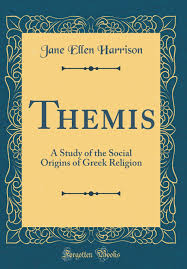
In her Themis, radical at the time in its assault on patriarchy, Harrison argues that Greek religion originated in a matrilineal (though not matriarchal) world. The cosmos was presided over by the goddess-like figure Themis  who stood “above the gods, supreme, eternally dominant … She is  … the collective conscience projected” (xvii). Themis was also “the very spirit of assembly incarnate” (485). She represents an early, pre-patriarchal worldview in which “man [sic] and nature form[ed] one, indivisible whole” (xviii).  

In this universe, plants and animals are equal to humans, and “if one member of that body suffer, or prosper, all the other members” do too. ( 533-34) Harrison asserts that ancient Greek religion enacted rituals to remind humans that they are merely a “specialized fragment” of a far larger whole of nature. (xix). These rituals, in which people, for example, would dress as animals, enacted getting into the skin of the non-human world in the same way a child might enter imaginatively into a painting.

Harrison considered the pantheon of patriarchal Zeus' family which replaced the earlier religion a sad diminution of the earlier Greek faith: in Zeus' world: “The family comes before us as the last forlorn hope of collectivism” (491). 

Harrison's words echo across time: in the twenty-first century it sometimes feels the only people we are allowed to fully care about beyond ourselves are immediate family members. This leads to a sad sense that community has diminished. Surely, too, if we are to save the planet we must come to understand once again that we are merely a “specialized fragment” of a far larger community. 

Harrison's thought  leads us to understand the importance of feeling a oneness or unity with the plant and animal world. It leads back as well to Woolf's Between the Acts


Woolf read Harrison's books, visited her in Mecklenburgh, and attended her funeral. In Between the Acts, her last work and one written under war's shadow, Woolf tried to transport the communality of ancient Greece that Harrison describes to England. With a Themis-like woman orchestrating the ritual, the entire community of an English village comes together for a pageant, including plants and animals. Miss La Trobe, the author, incorporates not only the village "idiot" but nature into her pageant to create an inclusive whole, the mooing of the cows and the start of rain incorporated into the rhythm of her performance. This accords, Wade notes, with what Harrison argued for in a book she gave Woolfher Ancient Art and Ritual, which asserts that the beginnings of Greek drama lie in “ancient community rituals” (Wade 286)  and ends by pushing for a return to “a communal style of art and living,” (Wade 288) as a way to avoid war. 

Woolf illustrates in Between the Acts an entire community, as in ancient ritual, for a transitory moment becoming one:
'A-maying, a-maying," they bawled. "In and out and round about, a-maying, a-maying. . .’” It didn't matter what the words were; or who sang what. Round and round they whirled, intoxicated by the music.
A May Day dance at a great house. Traditional rituals, Harrison and Woolf thought, could build inclusive community and promote peace. 


History has to be reframed, Woolf believed, to create a world without wars, a history of life, not death. But not everyone in Between the Acts is happy about the omission of warfare from the pageant's survey of Britain's past: 
Colonel Mayhew  asks “Why leave out the British army?,” a sentiment echoed by his wife: “Also, why leave out the Army, as my husband was saying, if it's history?”
And that question will lead us to another friend and contemporary of Woolf's dedicated to peace through a reformulation of what matters historically: historian Eileen Power, who will be the subject of the next blog.


Wednesday, January 22, 2020

Virginia Woolf's "The Leaning Tower," To the Lighthouse and Viva the Income Tax

In a late essay, "The Leaning Tower," a talk given to the Workers' Educational Association in Brighton in May, 1940 less than a year before her death and in the midst of World War II, Woolf makes a stunning claim. She asserts it as she envisions a post-war world where the "hedges" of social classes have been abolished and "all classes will be merged in one class."


Key to this transformation is the income tax, utterly central and integral in her mind to the better society waiting to be born. The "towers" that protect elites, she states, "will disappear," as will "class" because of


the income tax. The income tax is already doing in its own way what the politicians are hoping to do in theirs. The income tax is saying to middle-class parents: You cannot afford to send your sons to public schools any longer; you must send them to the elementary schools
This is stunning because of the context in which we have lived in the United States for the last forty years, where taxes have long been posited as the great, existential evil, the Satan rising dangerously to consume us above all the other arch-demons in the pantheon in hell. 

Woolf's advocacy of taxes should not hit with force of a shock: it should be a sensible idea that has been dunned into us with equal or greater force than that of lowering taxes as a supposed social good. But it has not been.


As Woolf understood, taxes are our boon and our power, even if we have, ostensibly, less money in our pockets on an individual level. If we tax high, especially the rich--as we have done in the past, in this country and the UK--abundant money exists (assuming we don't throw it into wars or walls) for social good: better education, better libraries (a system Woolf strongly supports in this talk), better roads, better healthcare, jobs, and, as the quote above indicates, a wealthier class that might have to rely on the same infrastructure we do.


And yet Woolf's advocacy shocks in its openness. It is more than a subversive whisper or an apologetic murmur to be shouted down in incandescent indignation. Instead it is states plainly what is censored and verboten in our society: taxes are a social good.  Education, too, she asserts in this essay is a great good in and of itself, a social force that in our society has been eroded as much as the tax base--and yet is still vitally important. In today's New York Times, for example, an op-ed piece quotes a scholar named Linda J. Skitka:


Every study I’ve ever seen across the social sciences shows that education promotes less in-group favoritism and greater tolerance toward those unlike ourselves,” she continued. “In panel studies that track the same people over time, as people gain advanced levels of education, they become more tolerant and favorable toward liberal democratic norms.” (https://www.nytimes.com/2020/01/22/opinion/trump-voters.html?action=click&module=Opinion&pgtype=Homepage)
No wonder that Woolf pushed her listeners to educate themselves.


The audience for Woolf's essay was working people, perhaps those who came bemused to see the famous and much caricatured Bloomberry. Yet continuing her Society of Outsiders theme from Three Guineas, she speaks to them as "us," finding common ground:

the immense class to which almost all of us must belong, to pick up what we can in village schools; in factories; in workshops; behind counters; and at home.
She goes on:
We can help England very greatly to bridge the gulf between the two worlds if we borrow the books she lends us and if we read them critically. …are we not commoners, outsiders?
Clearly, Woolf 's audience is working people, not of her class, and yet she is appealing to them in terms of "we." It could seem stunning--or disingenuous or dishonest (though more easily done in a time of war)--for her, the snobbish emblem of the upper crust, to speak with working people as if they are a "we." Yet she is being honest--and honesty about one's life was a key value for her, as she says in this essay. Self-honesty, Woolf states in the essay, is the only possible way to an honest literature--and only an honest literature can help people. 


I am rereading To the Lighthouse, always a stunning book if we are to be endlessly stunned--and am struck anew about how openly the novel explores identity as fluid and ever-changing, as created by people who see us one way and then another: Mr. Bankes is in one instance, struck dumb with love for Mrs. Ramsey, and a few hours later he hates her, feeling:


rigid and barren, like a pair of boots that have been soaked and gone dry so that you can hardly force your feet into them. 

Then he loves her again. Much of Lighthouse is an exploration of this kind of knowing of the other, through variable emotion, through touch, through constructing fictions, through an always veiled intimacy--and an exposé about how often we construct false narratives about people we know. In the long section of Lily's stream-of-consciousness near the end of the novel, she muses on Paul and Minta, who Mrs. Ramsey pulled together years ago:
He was withered, drawn; she flamboyant, careless. For things had worked loose after the first year or so; the marriage had turned out rather badly.

Yet Lily immediately goes on to think:
this making up of scenes about them, is what we call "knowing" people, "thinking" of them, "being fond" of them! Not a word of it was true;
she had made it up; but it was what she knew them by all the same.
This sense that what we grasp of people is both a fragment we think we know and yet incomplete and provisional, ("made ...up") is core to Woolf's thought and project. And yet we pigeonhole her all the time: she is, we say definitively, as if we know, a classist snob. When we do so, we can write her off, hate her, place ourselves in a superior position to her. Yet to pigeonhole her this way ironically violates exactly her life project of trying to understand people, leaving intact their layers of complexity so as not to reduce them to merely this or that, good or bad, lovable or detestable.

Woolf was both an insider snob and  an outsider. When she lumps herself with the working people listening to her talk, she is careful to tell the truth. She had spent her life as part of that "immense class" that picked up what education they could, where they could, in her case, mostly, at "home." In the world of education, at a time when women were earning advanced degrees and teaching at prestigious universities, she was largely self taught, with only some university day classes--perhaps more than we earlier knew--behind her, but never a degree that could open doors.  So insider/outsider, elite and not--this makes sense in context, but that is for the next blog.

Saturday, January 4, 2020

On Woolf, Cruelty, Kindness, and Self-Righteousness


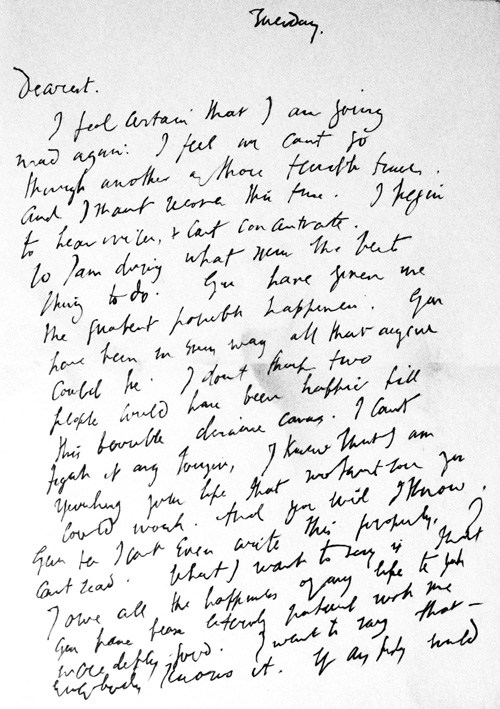
In a blog post about the response in the press to Virginia Woolf's suicide, Brainpickings cites the work of scholar Sybil Oldfield to show how one reader, the wife of the Bishop of Lincoln, misrepresented Woolf's anguished suicide letter as Woolf's cowardly inability to face the suffering others were bravely standing up against in the early years of World War II . This was a moment when the frightening possibility of a German invansion loomed large. To self-righteously judge Woolf for her suicide involved either willfully or unconsciously misreading her words. Even after Leonard wrote an outraged letter to The Sunday Times trying to set the record straight by quoting what Woolf actually wrote and explaining its context, the words were still twisted to label her a war shirking coward. The post, which I can't do justice to in summary, is superb and well worth examining in its entirety. If nothing else, it reminds us to carefully read the words people actually write: 


Woolf's suicide note


Brainpickings sums up the situation as follows:

Above all, however, embedded in the media’s treatment of Virginia’s suicide is a grotesque reminder that the only thing more morally repugnant than passing judgment on another human being’s private struggle and inner world — than choosing self-righteousness over compassionate understanding — is doing so publicly, especially as a currency of tabloidism. What a spectacular failing of the awareness that it’s far more rewarding to understand than to be right. One can only hope this awareness has evolved for us, both as a culture and as individuals, since Woolf’s time.

Unfortunately, the note of optimism that rang out in 2014 has become dimmed. 


An Op-Ed  by Paul Krugman  in The New York Times (https://www.nytimes.com/2019/12/23/opinion/ebenezer-scrooge-trump.html?action=click&module=Opinion&pgtype=Homepagelinked to a piece by Adam Serwer in The Atlantic: The Cruelty is the Point, Oct. 3, 2018:


I find convincing Henry Giroux's argument that we in the U.S. live in a "culture of cruelty" and so read Serwer's article with interest. Serwer moves in it from a recent trip he has made to the Museum of African American History and Culture in Washington, D.C. to the cruelty he argues that Trump's followers feel. He first writes of photos of whites proudly posed by the mutilated bodies of lynched black men:


Their cruelty made them feel good, it made them feel proud, it made them feel happy. And it made them feel closer to one another.

He then moves to Trump’s cruelty and  the cruelty of Kavanaugh and his friend laughing over what Kavanaugh was doing to the frightened Christine Blasey Ford. One of Serwer's chief points is that shared cruelty is a bonding mechanism: 

a vehicle for intimacy through contempt. The white men in the lynching photos are smiling not merely because of what they have done, but because they have done it together.

Serwer goes on to say:

Taking joy in that suffering is more human than most would like to admit. Somewhere on the wide spectrum between adolescent teasing and the smiling white men in the lynching photographs are the Trump supporters whose community is built by rejoicing in the anguish of those they see as unlike them, who have found in their shared cruelty an answer to the loneliness and atomization of modern life.
...
This isn’t incoherent. It reflects a clear principle: Only the president and his allies, his supporters, and their anointed are entitled to the rights and protections of the law, and if necessary, immunity from it. The rest of us are entitled only to cruelty, by their whim. This is how the powerful have ever kept the powerless divided and in their place, and enriched themselves in the process. 
The president’s ability to execute that cruelty through word and deed makes them euphoric. It makes them feel good, it makes them feel proud, it makes them feel happy, it makes them feel united.

Shared cruelty can bond people, either in exaltation or shame. Nevertheless, while he mentions it--"Once malice is embraced as a virtue, it is impossible to contain"--Serwer largely does not emphasize or unpack the underlying moralism that justifies exulting in cruelty.

As Serwer says, joy in suffering (schadenfreude or perhaps sadism) is not what humans like to admit. Therefore, the implicit assumption that underlies the naked pleasure in cruelty is righteousness. Those proudly photographed by the mutilated corpses of lynching victims would most likely say--and believe--that they were celebrating their part in making the community "safe" again from vicious thugs who deserved everything they got. The lynching in question was not an exercise in group sadism, but an exercise in community justice. 

I remember in the run-up to the Iraq war in 2003, when I was a religion reporter, the constant drumbeat of Christian right wing radio (now solidly behind Trump)  self-righteously praying not that the U.S. would have a change of heart and refrain from brutally invading another country, but that the Iraqis would see the error of their ways and humbly repent and beg forgiveness for having offended the United States. The not-too-subtle implication was that that if they did not prostrate themselves and do the impossible, such as depose Sadam Hussein, they "deserved" their fate. It was sad, but they had had their "chance," and if they didn't take it they had to learn a hard lesson.

This same mentality seems to permeate the thinking of Trump's most passionate supporters. While I might see it as sheer cruelty to separate a young child (who had no say in coming to this country) from his or her parents, I have heard people say that this is what the parents "deserve" for coming to this country illegally. It is their own fault for bringing their children here, and they--or their innocent children--have to suffer the consequences. It is not our cruelty to their children but their own. 


However, this self-righteousness, if integral to justifying cruelty, does also morph at times into open cruelty: Mrs. Trump's coat as she visited the immigrant children saying "I don't care, do you?" was openly cruel (however it was spun), as is a mocking "boo-hoo" emoticon of a crying figure that was apparently making the rounds in response to the outcry over separating immigrant children and parents.

Self-righteousness permeates the cruelty mind-set: blacks, women, immigrants, the LBGT ... community, have gotten away with "too much" and have to be stopped.  It is not cruelty to do so, the righteous assert, but righting wrongs: tough love, perhaps.

The largely secular wisdom book of Proverbs in the Bible, like its counterpart in the New Testament book of James, has something to say about righteousness: 

Proverbs 12:10 The righteous care for the needs of their animals, but the kindest acts of the wicked are cruel.

What this rather curious proverb says to me is that the truly righteous take care of those who can't take care of themselves in a straightforward way, but the wicked pretend that cruelty is kindness. 

Moving back to Woolf, while she seldom uses the word self-righteousness in her writing, condemnation of it permeates her thought. As she writes in The Common Reader,  in the essay “Notes on an Elizabethan Play:” "delightful though it is to indulge in righteous indignation" it is perhaps a feeling we want to avoid. (Perhaps the Bishop of Lincoln's wife should have read this essay?)


What becomes perplexing is tension between the need to take a stand at time when the choice between cruelty and kindness has seldom been more starkly laid out and the need not to become a mirror of the self-righteousness that morphs into a cruelty justified because the other side "deserves" it. It is so easy to be self-righteous on the left these days--and yet that stance, as Woolf might point out, is destructive. As the ship's captain warns Crusoe in Tournier's retelling of the Robinson Crusoe story,  Friday, purity, another form of self-righteousness is "the acid of the soul."  

Tournier, author of Friday


We need, at least imho, to keep focused on caring for the needs for others and trying to bring the systemic change that will right the wrongs done, not on retaliation or righteousness. 


Wednesday, April 24, 2019

Stonehenge and Virginia Stephen Woolf

Virginia and Vanessa and their brothers, in the prewar years, always spent August and September on "holiday."  During their 1903 holiday, they stayed in the Salisbury area. They were, therefore, able to return to Stonehenge a second time for a leisurely and (pleasantly) lonesome visit on September 5. I include much of Woolf's description because it shows how different the experience of Stonehenge was from how it is possible to experience it today, when it has become a very controlled and reconstructed world heritage tourist site. I was especially taken with Woolf's picture of the shepherds on Salisbury plain: what she is describes is not what you would see there today. 


Not quite Woolf's black-cape clad shepherds, but he does have a staff. 

I was also impressed with what a strong writer she was at this point, and with her touch of self irony in describing so romantic a scene as the shepherds. I took the time to really think about what it might like to stay in a spot for two months on holiday and have the ability to return to favorite destinations. Most of us see Stonehenge once and must move on (even if we happen to be living nearby, as I was in London).

Woolf's Stonehenge

It is also interesting to me that Woolf was reading Hardy's Tess at this time, and mentions it in her journal, but says nothing about imagining Tess at Stonehenge. I also find it fascinating that Woolf saw Stonehenge so strongly through a religious lens: when I was there I was interested in it primarily as a historic cultural site, an archeological "treasure." (And I just might have seen Tess ... :))


Woolf's diary of  Sept 5, 1903 
… our two visits to Stonehenge have impressed such pictures on my mind as I never wish to be obliterated. 
We made a second expedition today … I would rather call it a pilgrimage: because in truth we went with all reverence  with a pure design to enjoy ourselves. A day spent happily in the open air, counts, I am sure ‘whatever Gods there be,’ as worship; the air is a Temple in which one is purged of one’s sins.
We drove [in a horse-drawn cart] over the Downs, instead of the by-road, a straighter and more interesting way … a showery morning … 
On the plain itself, the only people we passed were shepherds, they drift about in the wide space with their flocks, just as though they were in the Bible; they take advantage of this wet weather too; to add one bold stroke to their appearance, which, I as an artist would hesitate to introduce; I should be half afraid of over picturesqueness: they wear long black cloaks reaching down to their heels, & flapping in capes round the shoulders:  in one hand too they grasp a real shepherds staff. You may actually see one of these figures lying on his elbow, wrapped in his cloak, his dog lolling out his tongue beside him, & his flock grazing all around.
We lunched—& we walked across to Stonehenge & sat within the Circle. Our choice of a day gave us the whole place to ourselves. The solitary policeman whose strange lot in life is to mount guard over Stonehenge had taken shelter behind one of his charges. The apoplectic sheep, who can imitate a standing motor car which is still palpitating to perfection, were grazing outside the Circle, & as far as we could see we had not only Stonehenge,  but the whole ocean of plain entirely to ourselves. One can imagine why this spot was chosen by the Druids—or whoever they were—for their Temple to the Sun. It lies very naked to the sun. It is a kind of altar made of earth, on which the whole world might do sacrifice.


Saturday, April 20, 2019

Virginia Woolf: Stonehenge Serendipities

Serendipity upon serendipity. I took with me to Malta (smushed into my luggage) the large hardback of Virgina's Woolf's first set of diaries, A Passionate Apprentice. While there, with two weeks to go before heading to Alton, England, I read the 1903 entries. In that year, she holidayed in Salisbury and went to Stonehenge. It dawned on me that I was soon going to be almost in the same spot: Alton is not far from Stonehenge. What a nice coincidence, I thought. Although we didn't visit, Roger and I drove past Stonehenge on the way to Bath and had a beautiful view. I was relieved the view hadn't been marred by a museum. It looked much as in the photo below:


Stonehenge today

The serendipities, however, did not end at me seeing Stonehenge not long after reading about Woolf visiting Stonehenge. 

Woolf writes about being surprised at how much smaller Stonehenge was than she envsioned: 


I suddenly looked ahead, & saw with a start that with which one sees in real life what ones eyes had always known in pictures, the famous circle of Stonehenge. Pictures give one no idea of size; & I had imagined something on a much larger scale. I had thought that the stones were scattered at intervals over a great space of the plain—so when we settled to meet the riders at ‘Stonehenge’  I had privately judged the plan to be far too vague. But really it is a tiny compact little place …
Stonehenge from around the time Woolf visited

A nineteenth century photo of Stonehenge


I came home from England and continued rereading a journal I had recently found from my time living in England in 1979. Almost immediately, I came across an entry about a trip I took  to Winchester/Stonehenge. Interesting, I thought. Even more so was what I wrote, on April 27, 1979 which I have utterly no memory of thinking: 


Stonehenge. Smaller than I expected. Films, the lying camera, made me imagine towering stone. Yet despite the smallness, it makes a deep impression. You stand on the top of a hill overlooking empty deep green plains on all sides. The wind cuts through clothing, whips back hair with brutal violence. It is still there but the guide’s voice screams into the wind. The stones stand, or lie, unmoved, solid, rugged, overlooking the plains. The mounds of Saxon kings circle the rocks. 
Arrangement of the rocks—like modern sculpture. There is a sense of history, of many centuries here,  the past entrenched here, and one can become part of that, yet remain distinct. It is the same almost as it was—the landscape, the plain, the rocks, the isolation. 
And here is more of Woolf, said far more elegantly and at greater length than me, but the same idea:


Nessa & I drove there [in a pony cart], 12 miles, all winding between the crest of the downs, with the Avon at our feet. It was, to give a most important setting to the scene, a brilliantly clear day; hot in the sun, fresh in the shadow, & the trees and the fields looked brisk & vigorous with the light on them, but by no means too hot. ...
The singular & intoxicating charm of Stonehenge to me, & to most I think, is that no one in the world can tell you anything about it. …Man has nothing to change Salisbury plain since these stones were set here; they have seen sunrise & moonrise over those identical swells & ridges for—I know not how many thousand years. I like to think of it; imagine those toiling pagans doing honor to the very sun now in the sky above me, & for some perverse reason I find this a more deeply impressive temple of Religion—block laid to block and half of them tumbled down in ruin so long that the earth almost hides them, then that perfect spire whence prayer & praise is at this very moment ascending.  


It was so startling for me to come across my own diary entry about Stonehenge, unread for forty years, just a few weeks after I had read Woolf's entry--and even more so to have had the same reaction that she did (even if not an unusual response). 

And now for the final serendipity, which ties back to Notre Dame and my previous blog on the narrative of place. As the photos above clearly show, the look of Stonehenge has changed since Woolf's time. I searched for old photos of Stonehenge to find a suitably "Woolfian" period photo and was stunned by the difference between then and now. The Stonehenge Woolf saw was not the same Stonehenge I saw in 1979 or a month ago driving by. I again note that what we see when we travel as tourists is a construct, a story. Who can say which is more "authentic"--"my" Stonehenge or "Woolf's"-- as the recent changes are clearly meant to make it more "authentically" what it was--or what we believe it to have been--in its heyday. 

Like the Notre Dame cathedral that burned, what is authenticity? That was already largely "restored" in a way that said more about nineteenth century interpretations of Gothic than what a medieval visitor would have seen. And it will be, as Europe always is, restored again. 

Finally, I can't help but quote at length from a humorous 2017 blog that dwells on this theme (and mentions size):

 From https://www.oise.com/blog/inventing-stonehenge


 Stonehenge was built in 1958. Our students go to investigate...It is sometimes hard to know what is authentic heritage, and what is not. ...
When we travel, we often create the things we expect to see. Quantum physicists know all about this phenomenon. ...But it would be harder, you would think, to create Stonehenge. Stonehenge is in truth pretty old (the landscape was worked on for a long time, but the stones will have been erected between 3000 and 2000 BC), but it has been touched up and ‘restored’ again and again through the nineteenth and twentieth centuries. In part, this was to secure the stones, to stop them from collapsing (one particularly crooked sarsen stone was straightened in the early twentieth century); but every time you touch something up it starts to look a little more like what everyone thinks it should look like. Archaeologists are on record stating that not a stone of Stonehenge has not been tinkered with in some way at some point in the last hundred years, and that it is ‘largely a product of the English Heritage Industry’. Thus it conforms, now, to expectations.
And for all that, not a single student I know who has been to see it has not remarked that it is much smaller than they thought. Perhaps some sort of gradual enlargement is the next step, if the British politico-military-industrial establishment can get its act together.