Wednesday, February 19, 2020

The Man in the High Castle, Swastika Night, and l'Ecriture Humaine

I finished Philip K Dick's The Man in the High Castle, which I read as a companion piece to Katherine Burdekin's Swastika Night, both novels imagining a future in which the Nazis have won World War II. I will briefly discuss The Man in the High Castle (Swastika Night is covered in other blog entries) and then evaluate both as l'ecriture humaine. L'ecriture humaine works from the premise that the stories we tell have implications for the lives we lead. What kind of stories are we telling as culture? Are they humane or inhumane? Do they lead us toward or away from compassion? 

L'ecriture humaine has four aspects:

1. It shines a light on personal domestic spaces, the spaces often overlooked, dismissed or derogated by the dominant discourse. These  spaces depict small scale community, class difference and sociality. They are where human relationships can be nurtured or exposed. If, as Stalin said, the death of one person is a tragedy and the death of a million a statistic, l'ecriture humaine focuses on the one person.

2. It tends toward the circular, not the linear. Life is not progress towards a defined end goal but a series of reiterative relationships, a return to the same ground in order to deepen it.  

3. It rejects degradation or humiliation of any individual or group as a rite of passage or a definition of their humanity.

4. It foregrounds empathy and compassion.


This is  always a literature of truth, not lies, of sentiment, not sentimentality,  of telling difficult stories with an ethical compass pointing at empathy, compassion and forgiveness.


A work of  l'ecriture humaine can be filled with violence, such as much holocaust literature is, but it nevertheless asserts humane values and censures degradation and horror. A l'ecriture that is not humane can, conversely, have no overt violence and can seem very beautiful and civilized while promoting an ethic of degradation and cruelty. To use the Nazi example again, as the good/evil divide is so clear there, much fascist literature uses beautiful language and description to exalt the 'Aryan' and whitewash violence and genocide as noble and pure.

Before reading The Man in the High Castle, I had watched the recent serialization of it through streaming it. It was an interesting experience to read the book after seeing the miniseries.

The series includes a compelling section not in the novel at all: it creates the story of John Smith, an all-American who throws his lot in with the Germans to become a very high-ranking and ruthless Nazi who yet loves his family. In this sub-plot he has to protect his son, who has a hereditary disease, from Nazi policy that require the adolescent boy be euthanized. The series also creates a dead sister for Juliana and makes Juliana a more central and sympathetic figure.

The book is more static and cerebral than the series, a luxury novels can afford, and focuses more intently on the Japanese occupation of the San Francisco area, Tao philosophy, and the I-Ching. Tagomi, a high ranking Japanese man, is a moral center in both the novel and the series, and in both cases, is able to cross the dimensional barrier between alternative histories, moving at times (though only once in the novel) into the world we know, in which the U.S. won the war. Spirituality and ethical living are central to Tagomi.

The bones of Dick's philosophy are buried under a plot that seems oddly peripheral to the central story, and therefore his philosophy becomes more ambiguous than in Burdekin. In a "say hello to the new boss/ same as the old boss," theme, the novel argues at the end that it doesn't make much difference who won the war while whoever is in charge oppresses those below, behaves violently, and has the nuclear capacity to destroy the earth. At the same time--and bumping up against this--is a portrayal of the Nazis as particularly evil, corrupt, stupid, and malevolent.

Burdekin makes an unequivocal case for nonviolence and woman's equality. Woman's equality is not  a subject on Dick's radar, and he shows ambivalent attitudes towards violence. Tagomi is deeply upset when he kills two Nazi agent/thugs, as killing violates his deepest moral principles. Juliana, however, almost mechanically uses a razor to cut the throat of Joe, her Nazi lover, after she discovers he plans to assassinate Hawthorne Abendsen, the "man in the high castle." (Abendsen, in Dick's novel,  wrote the alternative history novel that posits the Allies won the war.) Abendsen and his wife thank Juliana for her violent act, even though Abendsen lives unprotected and assumes he will be killed eventually.

Although all of Burdekin's central characters are men because the women have been reduced to a very low intellectual state, hers is far more the woman's novel in its sensitivity to women's plight and advocacy for appreciating the fully humanity of all people. Dick's characters are primarily men too, and they occupy a male world of business and politics. Even Childan's dinner at a Japanese couple's home is framed primarily as doing business--and Childan's interest in the Japanese wife is wholly sexual. The one female character to be fleshed out, Juliana, is exoticised and "orientalized," swinging between a surface self that is little more than a mildly sophisticated version of the "sexy, good-looking, crazy chick" and a mystical natural being with special spiritual insight. Abendsen calls her:

'a dathnon. A little chthonic spirit that ... roams tirelessly over the face of the earth.' He restored his glasses in place. 'She's doing what's instinctive to her, simply. expressing her being.'

Juliana in the novel is therefore a sex object, a crazy fucked up chick, and a mystical, spiritual, natural being--she is killer whore or redemptive goddess or nature symbol.

Burdekin's Swatiska Night works consistently in the genre of l'ecriture humaine:  the focus throughout, while espousing solidly articulated, general humane principles, is on the particular. There's no discussion of large scale military movements or battles, as in Dick's novel, which enjoys re-envisioning World War II battlegrounds.  This places Burdekin firmly in a mid-century feminist movement that included woman such as medieval and economic historian Elaine Power, and Virginia Woolf, who made it part of their politics to sideline war narratives, believing that real history lies in human community and that a constant narrative glorifying war meant ending war would be impossible.

Both Burdekin and Dick were interested in the spiritual. Burdekin ridicules Nazi spirituality but makes an impassioned defense of Quakerism--and her biography tells us she was interested in alternative religious views. Eastern religion is central to Dick.

Ultimately, both books have strongly anachronistic elements yet both make points that are, sadly, still highly relevant today.



Sunday, February 9, 2020

Parasite: Some thoughts on class

I recently saw the Korean film Parasite, directed by Bong Joon-ho, which features a sewage flood, and in one of those serendipities that often happens, a few days later, our toilet overflowed in what seemed an endless cascade of water that flooded our bathroom. The water was about a quarter inch deep, flowed into the hallway and even into the bedroom across the hall, then  leaked volumes into our basement. It was a mess, and even if at a much smaller scale, eerily similar to the raw sewage flood that goes shoulder high through the basement apartment of the poor lead family in Parasite.

The upshot of our personal contretemps with a flood of overflowing toilet water was exhaustion. I cleaned myself up and went to yoga, too tired to make the dinner I had planned. Roger, a valiant water battler, and Nick went to Subway.

This illuminates the logic of the poor family in the movie. The main poor characters almost always seem to eat out. I am aware, living in Barnesville, that an acute part of the class divide here is summed up in who cooks in--makes "real" meals--and who relies on fast food and junk food. Not making home cooked meals is looked down upon as a mark of being lower class.

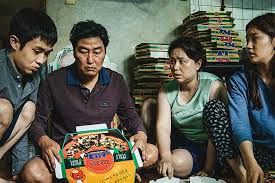
Parasite captures that: When our poor protagonist family earns some cash folding pizza boxes in their apartment, we next see them in a fast food type joint drinking sodas and eating bags of chips. Later, when the adult son and daughter land tutoring positions with a rich family, the first thing the foursome (including the parents do) is go to a cheap fast food buffet where they pile their plates high with food.

Folding boxes in their cluttered basement apartment

 The day after the unfortunate flood, the bathroom rugs duly washed, dried, fluffed and returned to the bathroom floor, I did make my planned meal of mushroom stroganoff, and as I did  I ruminated on how emblematic my easy ability to do so is of class position: how can this seemingly simple task be possible for people living in precarity?

I could make a stroganoff because I am not working on my feet all day or dealing with irate customers or facing a harrowing commute home, all of which easily leaves one too spent and exhausted to cook a complicated meal. I have also lived in the same home, with plenty of room and a large kitchen, for 11 years: therefore, I have all I need to cook at hand--thyme and worcestershire sauce in the cupboard, flour, butter, fresh mushrooms, onions, garlic, wine, organic vegetable broth. These are expensive and time consuming to gather all at once--for such cooking to be possible, such items have to be part of the normal flow of life, along with a full array of cooking utensils--measuring cups, spatulas, wire whisks, pots and pans, strainers, good knives, wooden spoons. And one has to have the energy to clean all this up.

It is easy to see how especially the mother in Parasite might not want to come home and cook and clean up after cooking and caring for another family all day. It is easy to see how the family, living precariously and in a home that might be prone to flooding, might not accumulate the necessary items to put together a home cooked meal even if they somehow could muster the energy.

Who can judge them for eating out?

Happily eating out:food is good when you have been hungry


The movie is a twist on the 1970s series Upstairs/Downstairs: as I was watching the poor family, who all insinuate themselves into employment as servants,  take advantage of the rich family's camping trip to bath in their tubs, eat their food, drink their alcohol and sprawl on their furniture, it instantly brought to mind a classic episode of the original series when the servants to do the same, though in their case they primarily dress up in their master's clothes--and drink their alcohol.

Likewise, the idea of the people at the bottom as tricksters who must live by their wits, fooling those at top, is a classic theme--and how often we have seen it in play. Further, when the rich family goes on a camping trip and thunder strikes, we know what is going to happen if they poor family, astonishingly, does not. But then, maybe not--how in touch would a poor urban family be with nature?

What the movie brought home--yet again--is the way poor working people have to efface themselves and be endlessly pleasant, upbeat, and helpful to their employers, who are oblivious to what they are undergoing. I was reminded of an article I read some years ago of Latino nannies in the L.A. area who learned very quickly to tell their would-be employers they had no children, as the employers didn't like the idea that the nannies they employed had loyalties to any children but their own.  This left the nannies not only with children at home, but having to juggle this without their employer's knowledge--a system very weighted to the emotional ease of the employers, who simply were alleviated of having to worry about another person's children, and to the added emotional stress of the nannies, who had to carry any childcare problems without employer support.

The husband in Parasite's rich family talks more than once about maintaining the "line" between the servants, in particular  his driver, the father in the family, and himself. The employer doesn't like servants crossing the "line." On the night the poor family is having a fine time and the storm drives the rich family home early, the rich couple decide to sleep on the living room sofa so they they can watch their son, who is outside inn a teepee. The father of the poor family is hiding under the sofa, and grows increasingly humiliated and enraged as the rich husband talks about him "crossing the line" with his bad smell of radishes. The rich husband reveals how oblivious he is to the challenges the poor family faces simply keeping clean to his standards.

The spacious, gracious uncluttered home of the rich is a contrast to the poor families' dingy, crowded apartment.


A surprise to me was finding out about others living secretly in the rich people's  house, but this shows that the secret lives of the poor have layers upon layers. A key privilege of class is the ability to remain oblivious, but this movie now makes that a little harder to do.

The poor family is not romanticized. They have a hard streak, well hidden (except in the case of the daughter) from the upper class through most of the movie. As an aside,  after watching this movie, Virginia Woolf leapt to mind: her delight in the later 1930s when she bought a piece of technology we all take for granted: a modern gas (or perhaps oil) range in which she could regulate the temperature. This meant she didn't have to incessantly watch whatever was cooking: she could put a cake or a roast in the oven, set the timer, and go back to her writing. This alleviated her of needing to hire a cook, for which she was ecstatic. She, too, talks about the line between servants and masters in her essays: in her case, the willingness of servants to engage with employers about their own lives after World War I was an important sign of social change.

I don't want to give away the ending of the film, but from the film, from Woolf, from so many others, it becomes clear that not needing servants is a boon to everyone involved, perhaps especially the servants themselves--as long as there are other, more productive means of employment, which it seems a wealthy, industrialized country could provide.


Wednesday, January 22, 2020

Virginia Woolf's "The Leaning Tower," To the Lighthouse and Viva the Income Tax

In a late essay, "The Leaning Tower," a talk given to the Workers' Educational Association in Brighton in May, 1940 less than a year before her death and in the midst of World War II, Woolf makes a stunning claim. She asserts it as she envisions a post-war world where the "hedges" of social classes have been abolished and "all classes will be merged in one class."


Key to this transformation is the income tax, utterly central and integral in her mind to the better society waiting to be born. The "towers" that protect elites, she states, "will disappear," as will "class" because of


the income tax. The income tax is already doing in its own way what the politicians are hoping to do in theirs. The income tax is saying to middle-class parents: You cannot afford to send your sons to public schools any longer; you must send them to the elementary schools
This is stunning because of the context in which we have lived in the United States for the last forty years, where taxes have long been posited as the great, existential evil, the Satan rising dangerously to consume us above all the other arch-demons in the pantheon in hell. 

Woolf's advocacy of taxes should not hit with force of a shock: it should be a sensible idea that has been dunned into us with equal or greater force than that of lowering taxes as a supposed social good. But it has not been.


As Woolf understood, taxes are our boon and our power, even if we have, ostensibly, less money in our pockets on an individual level. If we tax high, especially the rich--as we have done in the past, in this country and the UK--abundant money exists (assuming we don't throw it into wars or walls) for social good: better education, better libraries (a system Woolf strongly supports in this talk), better roads, better healthcare, jobs, and, as the quote above indicates, a wealthier class that might have to rely on the same infrastructure we do.


And yet Woolf's advocacy shocks in its openness. It is more than a subversive whisper or an apologetic murmur to be shouted down in incandescent indignation. Instead it is states plainly what is censored and verboten in our society: taxes are a social good.  Education, too, she asserts in this essay is a great good in and of itself, a social force that in our society has been eroded as much as the tax base--and yet is still vitally important. In today's New York Times, for example, an op-ed piece quotes a scholar named Linda J. Skitka:


Every study I’ve ever seen across the social sciences shows that education promotes less in-group favoritism and greater tolerance toward those unlike ourselves,” she continued. “In panel studies that track the same people over time, as people gain advanced levels of education, they become more tolerant and favorable toward liberal democratic norms.” (https://www.nytimes.com/2020/01/22/opinion/trump-voters.html?action=click&module=Opinion&pgtype=Homepage)
No wonder that Woolf pushed her listeners to educate themselves.


The audience for Woolf's essay was working people, perhaps those who came bemused to see the famous and much caricatured Bloomberry. Yet continuing her Society of Outsiders theme from Three Guineas, she speaks to them as "us," finding common ground:

the immense class to which almost all of us must belong, to pick up what we can in village schools; in factories; in workshops; behind counters; and at home.
She goes on:
We can help England very greatly to bridge the gulf between the two worlds if we borrow the books she lends us and if we read them critically. …are we not commoners, outsiders?
Clearly, Woolf 's audience is working people, not of her class, and yet she is appealing to them in terms of "we." It could seem stunning--or disingenuous or dishonest (though more easily done in a time of war)--for her, the snobbish emblem of the upper crust, to speak with working people as if they are a "we." Yet she is being honest--and honesty about one's life was a key value for her, as she says in this essay. Self-honesty, Woolf states in the essay, is the only possible way to an honest literature--and only an honest literature can help people. 


I am rereading To the Lighthouse, always a stunning book if we are to be endlessly stunned--and am struck anew about how openly the novel explores identity as fluid and ever-changing, as created by people who see us one way and then another: Mr. Bankes is in one instance, struck dumb with love for Mrs. Ramsey, and a few hours later he hates her, feeling:


rigid and barren, like a pair of boots that have been soaked and gone dry so that you can hardly force your feet into them. 

Then he loves her again. Much of Lighthouse is an exploration of this kind of knowing of the other, through variable emotion, through touch, through constructing fictions, through an always veiled intimacy--and an exposé about how often we construct false narratives about people we know. In the long section of Lily's stream-of-consciousness near the end of the novel, she muses on Paul and Minta, who Mrs. Ramsey pulled together years ago:
He was withered, drawn; she flamboyant, careless. For things had worked loose after the first year or so; the marriage had turned out rather badly.

Yet Lily immediately goes on to think:
this making up of scenes about them, is what we call "knowing" people, "thinking" of them, "being fond" of them! Not a word of it was true;
she had made it up; but it was what she knew them by all the same.
This sense that what we grasp of people is both a fragment we think we know and yet incomplete and provisional, ("made ...up") is core to Woolf's thought and project. And yet we pigeonhole her all the time: she is, we say definitively, as if we know, a classist snob. When we do so, we can write her off, hate her, place ourselves in a superior position to her. Yet to pigeonhole her this way ironically violates exactly her life project of trying to understand people, leaving intact their layers of complexity so as not to reduce them to merely this or that, good or bad, lovable or detestable.

Woolf was both an insider snob and  an outsider. When she lumps herself with the working people listening to her talk, she is careful to tell the truth. She had spent her life as part of that "immense class" that picked up what education they could, where they could, in her case, mostly, at "home." In the world of education, at a time when women were earning advanced degrees and teaching at prestigious universities, she was largely self taught, with only some university day classes--perhaps more than we earlier knew--behind her, but never a degree that could open doors.  So insider/outsider, elite and not--this makes sense in context, but that is for the next blog.

Saturday, January 4, 2020

On Woolf, Cruelty, Kindness, and Self-Righteousness


In a blog post about the response in the press to Virginia Woolf's suicide, Brainpickings cites the work of scholar Sybil Oldfield to show how one reader, the wife of the Bishop of Lincoln, misrepresented Woolf's anguished suicide letter as Woolf's cowardly inability to face the suffering others were bravely standing up against in the early years of World War II . This was a moment when the frightening possibility of a German invansion loomed large. To self-righteously judge Woolf for her suicide involved either willfully or unconsciously misreading her words. Even after Leonard wrote an outraged letter to The Sunday Times trying to set the record straight by quoting what Woolf actually wrote and explaining its context, the words were still twisted to label her a war shirking coward. The post, which I can't do justice to in summary, is superb and well worth examining in its entirety. If nothing else, it reminds us to carefully read the words people actually write: 


Woolf's suicide note


Brainpickings sums up the situation as follows:

Above all, however, embedded in the media’s treatment of Virginia’s suicide is a grotesque reminder that the only thing more morally repugnant than passing judgment on another human being’s private struggle and inner world — than choosing self-righteousness over compassionate understanding — is doing so publicly, especially as a currency of tabloidism. What a spectacular failing of the awareness that it’s far more rewarding to understand than to be right. One can only hope this awareness has evolved for us, both as a culture and as individuals, since Woolf’s time.

Unfortunately, the note of optimism that rang out in 2014 has become dimmed. 


An Op-Ed  by Paul Krugman  in The New York Times (https://www.nytimes.com/2019/12/23/opinion/ebenezer-scrooge-trump.html?action=click&module=Opinion&pgtype=Homepage) linked to a piece by Adam Serwer in The Atlantic: The Cruelty is the Point, Oct. 3, 2018:


I find convincing Henry Giroux's argument that we in the U.S. live in a "culture of cruelty" and so read Serwer's article with interest. Serwer moves in it from a recent trip he has made to the Museum of African American History and Culture in Washington, D.C. to the cruelty he argues that Trump's followers feel. He first writes of photos of whites proudly posed by the mutilated bodies of lynched black men:


Their cruelty made them feel good, it made them feel proud, it made them feel happy. And it made them feel closer to one another.

He then moves to Trump’s cruelty and  the cruelty of Kavanaugh and his friend laughing over what Kavanaugh was doing to the frightened Christine Blasey Ford. One of Serwer's chief points is that shared cruelty is a bonding mechanism: 

a vehicle for intimacy through contempt. The white men in the lynching photos are smiling not merely because of what they have done, but because they have done it together.

Serwer goes on to say:

Taking joy in that suffering is more human than most would like to admit. Somewhere on the wide spectrum between adolescent teasing and the smiling white men in the lynching photographs are the Trump supporters whose community is built by rejoicing in the anguish of those they see as unlike them, who have found in their shared cruelty an answer to the loneliness and atomization of modern life.
...
This isn’t incoherent. It reflects a clear principle: Only the president and his allies, his supporters, and their anointed are entitled to the rights and protections of the law, and if necessary, immunity from it. The rest of us are entitled only to cruelty, by their whim. This is how the powerful have ever kept the powerless divided and in their place, and enriched themselves in the process. 
The president’s ability to execute that cruelty through word and deed makes them euphoric. It makes them feel good, it makes them feel proud, it makes them feel happy, it makes them feel united.

Shared cruelty can bond people, either in exaltation or shame. Nevertheless, while he mentions it--"Once malice is embraced as a virtue, it is impossible to contain"--Serwer largely does not emphasize or unpack the underlying moralism that justifies exulting in cruelty.

As Serwer says, joy in suffering (schadenfreude or perhaps sadism) is not what humans like to admit. Therefore, the implicit assumption that underlies the naked pleasure in cruelty is righteousness. Those proudly photographed by the mutilated corpses of lynching victims would most likely say--and believe--that they were celebrating their part in making the community "safe" again from vicious thugs who deserved everything they got. The lynching in question was not an exercise in group sadism, but an exercise in community justice. 

I remember in the run-up to the Iraq war in 2003, when I was a religion reporter, the constant drumbeat of Christian right wing radio (now solidly behind Trump)  self-righteously praying not that the U.S. would have a change of heart and refrain from brutally invading another country, but that the Iraqis would see the error of their ways and humbly repent and beg forgiveness for having offended the United States. The not-too-subtle implication was that that if they did not prostrate themselves and do the impossible, such as depose Sadam Hussein, they "deserved" their fate. It was sad, but they had had their "chance," and if they didn't take it they had to learn a hard lesson.

This same mentality seems to permeate the thinking of Trump's most passionate supporters. While I might see it as sheer cruelty to separate a young child (who had no say in coming to this country) from his or her parents, I have heard people say that this is what the parents "deserve" for coming to this country illegally. It is their own fault for bringing their children here, and they--or their innocent children--have to suffer the consequences. It is not our cruelty to their children but their own. 


However, this self-righteousness, if integral to justifying cruelty, does also morph at times into open cruelty: Mrs. Trump's coat as she visited the immigrant children saying "I don't care, do you?" was openly cruel (however it was spun), as is a mocking "boo-hoo" emoticon of a crying figure that was apparently making the rounds in response to the outcry over separating immigrant children and parents.

Self-righteousness permeates the cruelty mind-set: blacks, women, immigrants, the LBGT ... community, have gotten away with "too much" and have to be stopped.  It is not cruelty to do so, the righteous assert, but righting wrongs: tough love, perhaps.

The largely secular wisdom book of Proverbs in the Bible, like its counterpart in the New Testament book of James, has something to say about righteousness: 

Proverbs 12:10 The righteous care for the needs of their animals, but the kindest acts of the wicked are cruel.

What this rather curious proverb says to me is that the truly righteous take care of those who can't take care of themselves in a straightforward way, but the wicked pretend that cruelty is kindness. 

Moving back to Woolf, while she seldom uses the word self-righteousness in her writing, condemnation of it permeates her thought. As she writes in The Common Reader,  in the essay “Notes on an Elizabethan Play:” "delightful though it is to indulge in righteous indignation" it is perhaps a feeling we want to avoid. (Perhaps the Bishop of Lincoln's wife should have read this essay?)


What becomes perplexing is tension between the need to take a stand at time when the choice between cruelty and kindness has seldom been more starkly laid out and the need not to become a mirror of the self-righteousness that morphs into a cruelty justified because the other side "deserves" it. It is so easy to be self-righteous on the left these days--and yet that stance, as Woolf might point out, is destructive. As the ship's captain warns Crusoe in Tournier's retelling of the Robinson Crusoe story,  Friday, purity, another form of self-righteousness is "the acid of the soul."  

Tournier, author of Friday


We need, at least imho, to keep focused on caring for the needs for others and trying to bring the systemic change that will right the wrongs done, not on retaliation or righteousness. 


Friday, January 3, 2020

Bride of Northanger, part II, without spoilers

I finished Diana Birchall's The Bride of Northanger, a sequel to Austen's Northanger Abbey, and find myself in the perplexing position of hoping to discuss it without giving away the plot points. Onward we plunge.


We were left at the end of the last post with a possible ghost in the form of the Grey Lady seen floating around the abbey, as well as a possibly poisoned General Tilney. The plot only gets more exciting with a pile up of events that keep the pages turning. We are also offered reunions with familiar characters from Northanger Abbey, including the brother and sister duo we love to hate, John and Isabella Thorpe. Needless to say, they add greatly to the excitement that unfolds in the novel's latter section.

But The Bride of Northanger is also lovely in its quiet moments. Despite all the suitably dramatic events going on at the abbey, Diana takes the time to depict the happy marriage of Henry and Catherine amid the peaceful setting of Woodston, Henry's--and now Catherine's-- parsonage home. Catherine's little sister Sarah comes to visit and admires the "lovely long windows" and the view of the "apple-trees ripening so beautifully." We learn from the narrator that:

the summer weather continued golden and delightful, with the sweet strawberries reddening, and Catherine was in the garden more than half the day, pruning plants, and learning to tell which were weeds.

Clearly, Catherine has more fortitude and realism that Mrs. Elton, who couldn't last half an hour in the Donwell Abbey strawberry patch, though, in Mrs. Elton's defense, she picked there on an exceptionally hot day. Woodston, in any case, is an Edenic contrast to the increasingly troubled Northanger Abbey, though notably in the end, perhaps like Adam and Eve, Henry and Catherine put their shoulders to the grindstone and decide to leave their paradise.

But that is not until many adventures have occurred, including, suitably, a trip to Bath.

The novel revels in Gothic elements Austen clearly enjoyed in her own novel reading, though she also parodied them. There is an edge of gentle parody in this novel too, even while the story is told in a way that fully satisfies the reader's desire for mystery archetypes--a desire that Austen thwarts. I enjoyed this book and can't help but imagine that others will too.


Tuesday, December 31, 2019

Greta Gerwig's Little Women

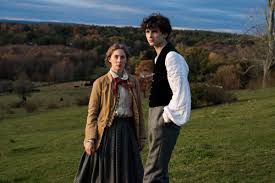
I saw the latest Little Women last week and fell in love with it, but was not going to blog about it until I read it criticized for its use of flashbacks. I suppose the film will stand or fall on one's reaction to Gerwig's technique--and those who dislike it are surely held in respect--but I would like to make a defense, first, of Gerwig's flashbacks, and then of the film's larger vision.


As I child, I was given a copy of Little Women with a garish cover, and by the time I was nine, I had fallen in love with the book, in part with wonder at its strange (to me) sentimentalism. I reread it as an adult--my memory is that Roger and I read it aloud as newlyweds--and I reacted to the book in a  different way than as a child. This time I appreciated the deep drenching sadness and loneliness--the bleak depression--Jo faces as an adult when her family of origin breaks apart. It is all loss for her: Meg marries and leaves to begin her own life, Amy travels with Aunt March to Europe, and the lingeringly ill Beth finally dies. Jo stares into a black abyss of desolate loneliness, full of longing for times past, when she had place and companionship. It is as bleak and realistic a portrait as any of what solitary people, male or female, in real life face as props are pulled away. I began to see this as an adult novel--and I think it is no accident that I have been drawn to figures like Austen and Bonhoeffer who faced similar loss.

This bleakness, however, is left out--if I remember correctly--of all the filmed versions I have seen. These cover the basic plot points and the happy marriages (along with the tear-jerking death of Beth) but elide Jo's internal anguish.


By using a flashback technique, Gerwig is able to incorporate Jo's suffering into the plot. The plot moves back and forth between the losses of the "present day," and the jolly days when the girls were all at home together. We encounter Jo, full of the confidence of youth and still surrounded by family, able to tell Laurie the truth: that she can't love him the way he wants. Later, with Beth dead and the house empty of sisters and laughter, Jo is broken, and marriage with Laurie, even if she doesn't love him, seems better than the heartbreaking, soul-killing alternative of loneliness, as she tells her mother. She puts a letter to Laurie, soon to return from Europe, in the knothole of a tree, telling him she will marry him--only to have to retrieve when he returns with Amy as his bride.  This loneliness is central to the story Gerwig has to tell.

Gerwig is also able to avoid what I call the Hamlet problem through the flashbacks--in staging a story so iconic and well known, that has been "done" so many times, how do you avoid going through the predictable paces that cover the familiar episode set-pieces in a stale and predictable way? How do you keep it fresh? Flashbacks are Gerwig's answer--and I felt she handled them expertly.

On a deeper and broader level, I appreciated the humane vision that animated the film. It was beautiful in terms of costumes and settings, but also in terms of articulating generous and compassionate values. I loved, for example, the moment when Jo is urging Meg, more than half seriously, to run away with her rather than marry John Brooke. Meg says to her sister that they are different. The freedom and career Jo centrally hungers for is not the same as the love and domesticity Meg craves. Meg wants what she wants with the same fervor as Jo, and she tells her sister that both goals are worthy. One goal is not better than the other. One goal doesn't have to win, shriveling the other. One sister doesn't have to sacrifice her dreams for the other. The dreams can both coexist and both be good. I have never heard a better or a gentler rejoinder to the "Mommy Wars." Or a better rejoinder to triumphalism and hierarchy: Meg tells us we can all live and pursue our paths side by side and equally, and the world is richer for it. Meg is unthreatened by Jo's ambitions--and in the end Jo is unthreatened by Meg's. This is a world--fantasia though it might be at the present moment--that I would love to live in.


Gerwig also shows the four sisters as markedly different people and illustrates that all forms of being are acceptable. No one is judged. Meg wants husband and family: that is good and worthy. Jo is ambitious to become a published writer: ambition is good and worthy. Beth is a creative soul who wants to pursue the music she loves without any ambition to perform publicly or make a name for herself: that is good and worthy. Amy--an enormously well realized character in this film--wants material well-being because she knows what poverty and worry is: that is good and worthy. All of these woman achieve their goals--and all do so without selling their souls. They all love each other: whatever each one is is fine, and they don't have to be the same.

In this light, I loved Gerwig's handling of Professor Bhaer--made a young and attractive German counterpart to Laurie (though much poorer). Since I find the Professor Bhaer of the novel an overbearing, patriarchal jerk who takes it on himself to (very gently of course) to show Jo the folly of her ways as if she is silly child--judging her and finding her wanting--I derived intense satisfaction when Gerwig's Jo let's him have it with no holds barred. You go girl, as they say. And in Bhaer's (Frederick in the movie) defense, he did mean well--and Jo ultimately takes his advice.

Gerwig follows the plot of the 1994 movie in merging Jo the character with Alcott the author, and in the end, this Jo too pens Little Women--and the marriage with Bhaer is depicted as existing only in the fantasyland of literature. Gerwig's Jo stays, like Alcott, stubbornly single, showing the single path as another viable option for a woman.

The movie has been criticized for excising the Christian theme that structures events in the novel around Bunyan's Pilgrim's Progress, a book each girl receives early on as her sole Christmas gift. I noticed that and saw it as a reworking or even distortion of the book, but in today's political climate, with so much of evangelical Christianity prostrated to violent authoritarianism, Gerwig at least has avoided muddying her message or being co-opted into something she is not.


Men are peripheral in this novel, despite Meg's love of John, and Laurie's important part in the girls' lives. The women live their lives on their own terms, pursuing their own dreams. It was quite refreshing to me, coming after so many films that still--even in the second decade of the twenty-first century--exalt the great man surrounded by female handmaids ready to sacrifice their being for him and put up with his rages, moods, and betrayals--Phantom Threads jumps to mind--there are so many others, and we are prompted to receive them as great cinema, repugnant as they are. Some men may not like this movie, as no woman is ever a handmaiden--not even Meg to John. But it is a movie men can learn from. If our grand leader could understand its compassionate core, the world would be a different place.

Finally, it is the compassionate core that matters. The folding in of pain and suffering that Gerwig is able to achieve through her flashback technique is integral to not sentimentalizing her vision. This is a work of sentiment, but it is not sentimental in a false way that erases pain: Jo, for example, cries in anguish after she sells her hair.

There is so much more to say--and the film is not without its minor flaws and rubs but this is a defense--and I will end here. The costumes, settings, beauty, and female energy animating the movie are breathtaking. The compassion and affirmation of woman, of equality, of space for different kinds of lives to coexist without rancor or violence, should receive our strongest support as a vision of a world where we can all have life, fulfillment and hope without having to tear each other down.

I have not yet read a review, blog, or interview about this movie, though I am aware Amy's character has been praised and that the film has been overlooked for awards. Perhaps now that I have written about it from my own heart I will look at what others--including Gerwig--have to say. 

Bride of Northanger, part I

I am reading Diana Birchall's The Bride of Northanger, a sequel to Jane Austen's Northanger Abbey.

I am a little more than a third of the way through the book as I write. It picks up as Henry Tilney and Catherine Morland marry and begin life together. If Austen poked fun at Catherine's Gothic pretensions and desire to bring the frisson of Gothic literature into a real abbey that is all too modern and prosaic to be romantic and frightening, this novel turns that trope entirely on its head.


Catherine and Henry now begin to experience some Gothic horror. Not only does Henry reveal a curse that says wives of the eldest Tilney son are fated to suffer misfortune (fortunately for Catherine, Henry has an older brother!), Catherine and Henry find a note stuck to a knife thrust into the door of their room while visiting Northanger Abbey. The note warns Catherine away from the abbey and tells her never to return. The knife is an open threat of violence. This is in addition to new china sent by General Tilney to their home that seems to have the word "maledict" written in tiny script amid the scrolling leaves of the china pattern.

The Gothic touches keep the pages turning, and more importantly, tap into archetypes from girls' literature that are deeply satisfying: secret curses, poison pen letters, even a (seeming) ghost. This is the stuff of Nancy Drew and other classic mystery novels (which I rate very highly), and it is delightful to see these elements transferred to an adult novel.


Another apt--and important--touch is General Tilney's  love of fine china. It allows for the introduction of sensuous elements into the book, but also advances the plot, especially when the general shows off his Medici goblet made of cobalt blue glass flecked with gold--a goblet that will shatter if any poison is poured into it. Needless to say, without giving anything away (and I do not yet know what will happen), the goblet does shatter, the general perhaps poisoned .... Add to that Catherine's sighting of the mysterious and ghostly Grey Lady and the plot has thickened greatly.

I look forward to seeing how the plot unfolds--and plan to post again when I have finished the book. I would recommend it thus far as a fine, old-fashioned, and entertaining read.

In the interests of full disclosure, Diana has been a cyber-companion with whom I have shared the Austen passion for more than a decade.